
Incidence and Associations of Normal QRS vs Right Bundle Branch Block in Ebstein's Anomaly
Abstract Body (Do not enter title and authors here): Introduction: Ebstein's anomaly (EA) is associated with ECG signature of right bundle branch block (RBBB). Patients with EA also have high incidence of accessory pathways (AP) and it has been hypothesized that the absence of RBBB on ECG may be associated with a higher prevalence of AP. This study aims to assess the prevalence of RBBB in patients with EA and examine the correlation between its absence and the presence of AP.
Methods: Adults (age>18 years) with EA, identified using the Mayo Adult Congenital Heart Disease registry, were divided into 3 groups based on the QRS morphology of their first ECG. Those with prior AP ablation were excluded. The demographic characteristics, baseline ECG data, echocardiographic parameters and EP study data were retrospectively collected and compared between the three groups using Chi-square or ANOVA test as appropriate.
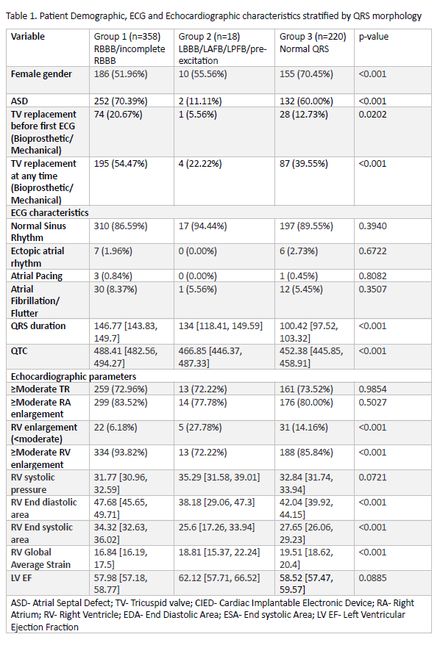
Results: Of 596 patients with EA, 358(60.06%) patients had a RBBB, bifascicular block or an incomplete RBBB (group1) ; 18 (3.02%) patients had either a LBBB , ventricular pre-excitation, isolated left anterior or posterior fascicular block (group 2); and 220 (36.92%) patients had normal QRS (group 3). The characteristics of these groups are compared in the table. Patients with RBBB had larger RV size, reduced RV systolic function and higher likelihood of tricuspid valve surgery. EP study was performed in 51 (14%), 3 (17%) and 51 (23%) patients in groups 1, 2,and 3 respectively. One or more APs were noted in 11/51 (22%) and 14/51 (30%) patients with RBBB and normal QRS respectively (p=0.18). Additionally, in patients who did not undergo an EP study, supraventricular tachycardia was documented in 39/307 (13%), 2/15(13%) and 13/169 patients (8%) in group 1,2 and 3 respectively during followup .
Conclusion: In a large cohort of adults with EA in a tertiary referral center, greater than one-third of patients had a normal QRS complex without RBBB. However, EP study did not reveal a significant difference in the prevalence of accessory pathways between patients with and without RBBB. In EA, the absence of RBBB may not increase the risk of an underlying accessory pathway.
Havangi Prakash, Shisheer
(
Mayo Clinic
, Rochester , Minnesota , United States )
Poddar, Aastha
(
Mayo Clinic
, Rochester , Minnesota , United States )
Connolly, Heidi
(
Mayo Clinic
, Rochester , Minnesota , United States )
Egbe, Alexander
(
Mayo Clinic
, Rochester , Minnesota , United States )
Madhavan, Malini
(
Mayo Clinic
, Rochester , Minnesota , United States )
Author Disclosures:
Shisheer Havangi Prakash:DO NOT have relevant financial relationships
| Aastha Poddar:No Answer
| Heidi Connolly:DO NOT have relevant financial relationships
| Alexander Egbe:No Answer
| Malini Madhavan:No Answer