Relationships Between Degree of Obesity, Transthoracic Impedance, and Cardioversion Efficacy
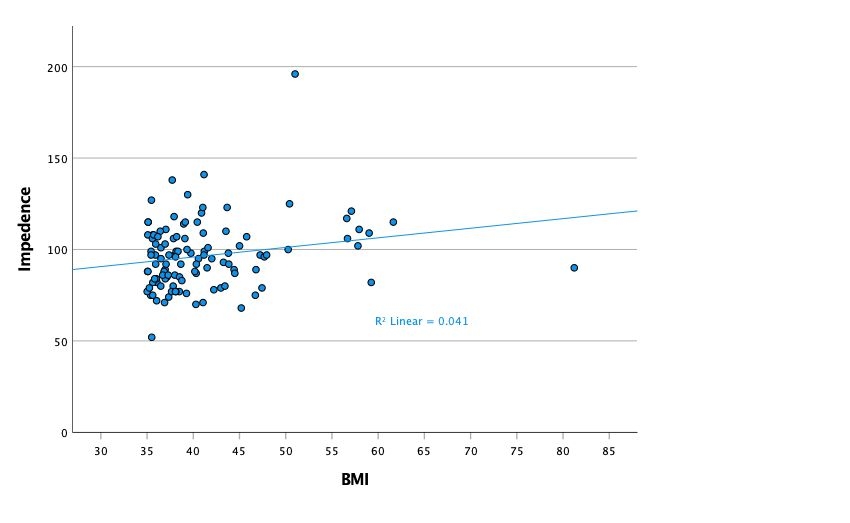
Abstract Body (Do not enter title and authors here): Background: In our recent multicenter randomized clinical trial comparing the efficacy of single versus dual direct current cardioversion (DCCV) in patients with significant obesity (body mass index [BMI] ≥35 kg/m2) undergoing DCCV for atrial fibrillation (AF), we found higher success rates using dual-DCCV. In addition to total energy applied, another important parameter is transthoracic impedance (TTI), as it impacts myocardial current density. Higher TTI is associated with DCCV failure. Previous studies found a positive correlation between BMI and TTI among normal-BMI patients (B=1.9 Ω/[kg/m2]). Whether there is a significant relationship between BMI and TTI in obese patients is unknown.
Objective: In this post-hoc analysis of the dual-DCCV study, we investigated whether further increase in BMI above 35 kg/m2 correlates with increasing TTI, and whether TTI impacts procedural success in obese patients.
Methods: Of the 200 patients included in the primary study, impedance data were available for 112. The relationship between BMI and TTI was compared using linear regression, and t-tests were used to assess whether DCCV efficacy varied significantly with BMI or TTI.
Results: Among these 112 patients (age 65±11 years, BMI 41±7 kg/m2, 36 [32%] female, 17 [15%] Black), increasing BMI was weakly associated with a small, though statistically significant, increase in TTI (R2=0.04, B=0.53, p=0.03). There was no difference between patients with successful cardioversion (n=101) vs. failure (n=11) in terms of BMI (41±6 vs. 44±14 kg/m2, p=0.16) or TTI (96±19 vs. 98±18 Ω, p=0.81). These relationships were also true when the analysis was limited to participants receiving single-DCCV (n=57; with success in 48 [84%]): 41±6 vs. 45±15 kg/m2, p=0.21; and 98±15 vs. 102±17 Ω, p=0.48.
Conclusion: In patients with Class 2 or higher obesity undergoing DCCV, there is a weaker association between further increase in BMI and TTI than previously found among patients with BMI <35 kg/m2. Further, in this high BMI population, there is no difference in TTI or BMI based on success or failure of DCCV.
Sanchez, Alexandra
(
Ochsner Health
, New Orleans , Louisiana , United States )
Murphy, Barret
(
Ochsner Health
, New Orleans , Louisiana , United States )
Aymond, Joshua
(
Ochsner Health
, New Orleans , Louisiana , United States )
Bernard, Michael
(
Ochsner Health
, New orleans , Louisiana , United States )
Hiltbold, Aimee
(
Ochsner Health
, New Orleans , Louisiana , United States )
Khatib, Sammy
(
Ochsner Health
, New orleans , Louisiana , United States )
Polin, Glenn
(
Ochsner Health
, New Orleans , Louisiana , United States )
Rogers, Paul
(
Ochsner Health
, New Orleans , Louisiana , United States )
Castine, Michael
(
Ochsner Health
, New Orleans , Louisiana , United States )
Morin, Daniel
(
Ochsner Health
, New Orleans , Louisiana , United States )
Author Disclosures:
Alexandra Sanchez:DO NOT have relevant financial relationships
| Daniel Morin:DO have relevant financial relationships
;
Researcher:Abbott:Past (completed)
; Speaker:Medtronic:Past (completed)
; Speaker:Boston Scientific:Past (completed)
; Speaker:Abbott:Past (completed)
; Speaker:Zoll:Active (exists now)
| Barret Murphy:No Answer
| Joshua Aymond:DO NOT have relevant financial relationships
| Michael Bernard:No Answer
| Aimee Hiltbold:No Answer
| Sammy Khatib:No Answer
| GLENN POLIN:No Answer
| PAUL ROGERS:No Answer
| Michael Castine:DO have relevant financial relationships
;
Speaker:Zoll:Active (exists now)