
Logo

American Heart Association

  120
  0


Final ID: 4144765

Delayed Management in the Borderline Left Heart Provides Additional Insight Into the Left Heart Potential

Abstract Body (Do not enter title and authors here): Introduction: Prediction of successful biventricular outcome following a fetal diagnosis of borderline left heart (BLH) can be challenging. A postnatal algorithm of delaying interventional decisions to allow for optimized left heart preload and consequent growth was therefore developed. We review our experience, examining changes in left heart dimensions and clinical outcomes using this algorithm.
Methods: We identified all fetal BLH cases encountered in our institution from 9/2008-4/2024 with neonatal management and a repeat postnatal preintervention echo available. BLH was defined as a left ventricular (LV) end diastolic dimension(LVEDd) and/or mitral valve(MV) diameter (4 chamber) z score of <-2 at last fetal echo. Pre and postnatal medical records were reviewed. Z-scores of LVEDd, MV and aortic valve(AoV) diameters and LV end diastolic volume indexed to body surface area(LVEDVi)), and left/right heart ratios were compared between initial neonatal echo and either last echo before intervention or at <6 weeks in those without intervention. Findings were also compared between those with vs without a successful biventricular(BiV) outcome.
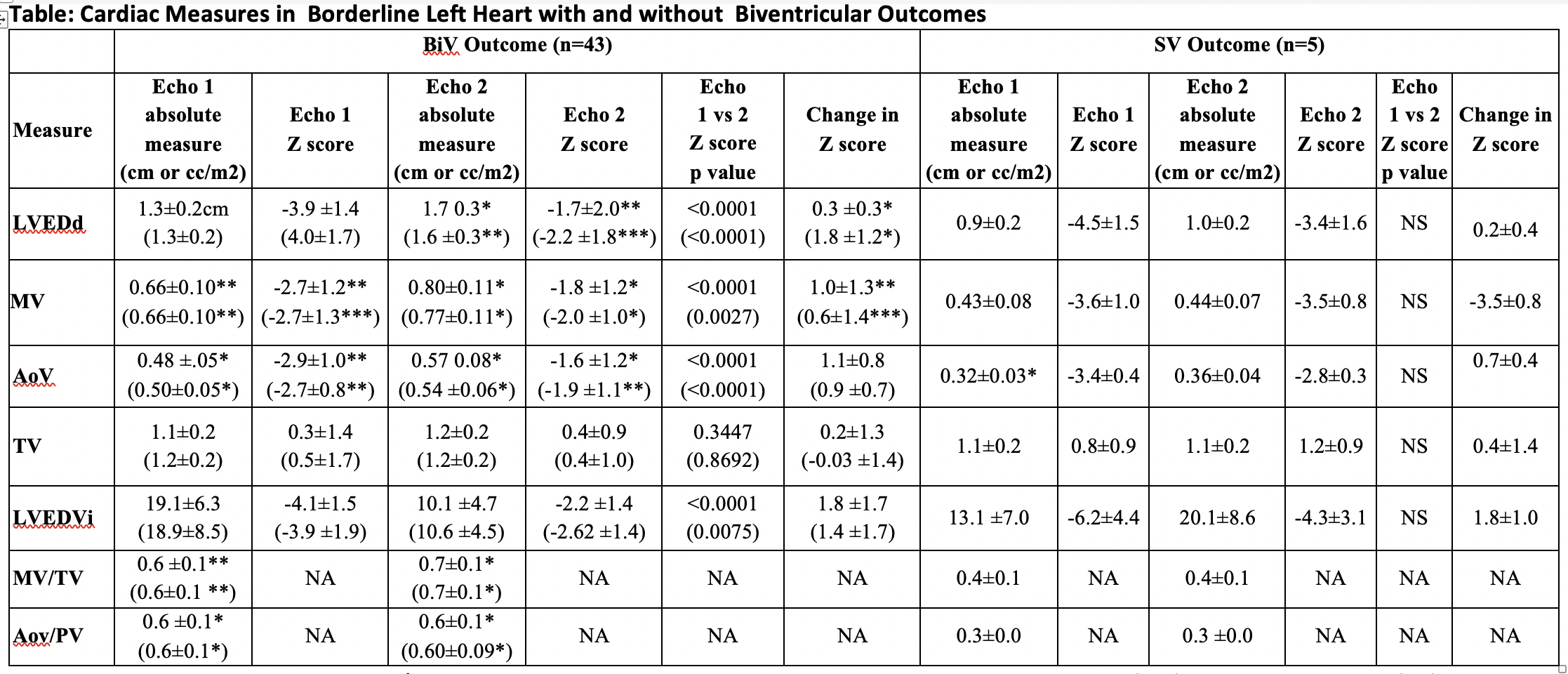
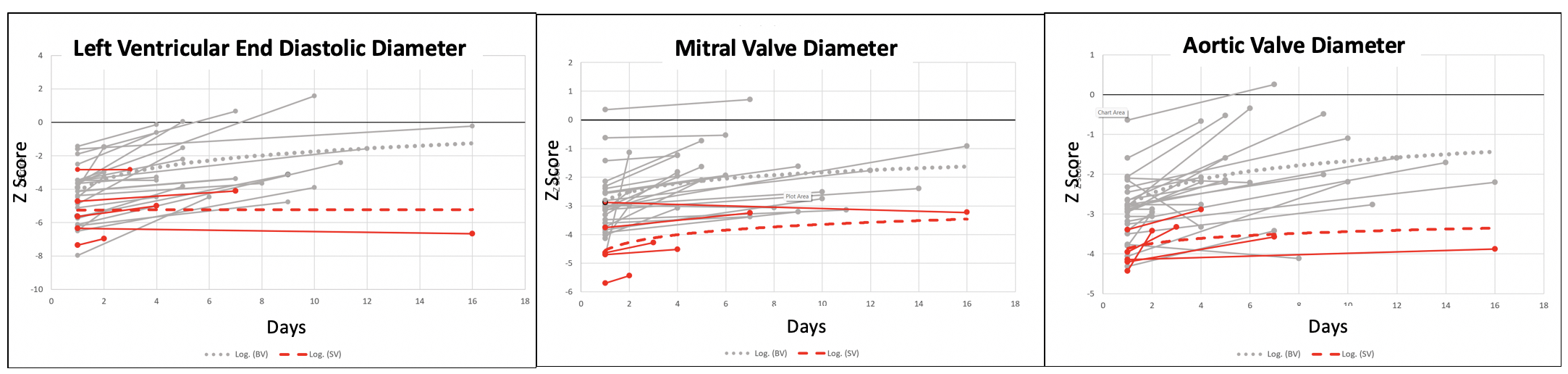
Results: Forty-eight fetuses with a BLH were included. Mean gestational age at last fetal echo was 35.2±2.4 weeks and at birth 38.3±2.0 weeks, and birth weight was 3.0±0.7Kg. Successful BiV outcome occurred in 43(90%), 35 following neonatal intervention (31 with coarctation/arch repair +/- ventricular septal defect), whereas, 5(10%) required single ventricle(SV) palliation (Norwood in 4, transplant with failed BiV repair in 1). Findings at initial (day 1) and repeat echo (BiV 13.8±12.9 and SV 6.4±5.1 days) are presented in the table. Initial MV and AoV diameters and left/right valve ratios were greater and there was a significant increase in size with time for LVEDd, MV and AoV in the BiV compared to the SV group (Table, Figure). When comparing only BiV neonates with surgical intervention who had a similar interval to 2nd study as SV neonates (6.7 ±3.7days), significant increase in LVEDd and MV size occurred in BiV but not SV neonates. All but 1 BiV infant (noncardiac death at 5 months), survived with mean age at last follow-up of 6.0±4.4years.
Conclusions: Delayed decision making confers valuable data about the left heart potential in the BLH newborn. Smaller initial MV and AoV and little or no change in LVED and MV dimensions may be useful in identifying those who should undergo SV palliation.
  • York, Emitt  ( University of Alberta, Stollery Chi , Edmonton , Alberta , Canada )
  • Eckersley, Luke  ( University of Alberta, Stollery Chi , Edmonton , Alberta , Canada )
  • Haberer, Kim  ( Cohen Children's Hospital , New Hyde Park , New York , United States )
  • Mcbrien, Angela  ( University of Alberta, Stollery Chi , Edmonton , Alberta , Canada )
  • Hornberger, Lisa  ( University of Alberta, Stollery Chi , Edmonton , Alberta , Canada )
  • Author Disclosures:
    Emitt York: DO NOT have relevant financial relationships | Luke Eckersley: DO NOT have relevant financial relationships | Kim Haberer: No Answer | Angela McBrien: DO NOT have relevant financial relationships | Lisa Hornberger: DO NOT have relevant financial relationships
Meeting Info:

Scientific Sessions 2024

2024

Chicago, Illinois

Session Info:

Congenital Heart Surgery and ACHD

Saturday, 11/16/2024 , 01:30PM - 02:45PM

Abstract Oral Session

More abstracts on this topic:
Does Knowledge of Anti-Ro Antibody Status Before Pregnancy Affect Diagnosis of Fetal Cardiac Neonatal Lupus? A Fetal Heart Society Research Collaborative Study

Kaplinski Michelle, Krishnan Anita, Hogan Whitnee, Sharma Kavita, Ikemba Catherine, Levasseur Stephanie, Owens Sonal, Deweert Katherine, Kohari Katherine, Copel Joshua, Bucholz Emily, Kaizer Alexander, Gilbert Lisa, Srinivasan Shardha, Samples Stefani, Patel Angira, Phoon Colin, Srinivasan Ranjini, Mcintosh Amanda, Kiaffas Maria, Geiger Miwa, Mcfarland Carol, Cuneo Bettina, Pinto Nelangi, Arya Bhawna, Doan Tam, Moreno Jamine, Lindblade Chris, Gropler Melanie, Buyon Jill, Killen Stacy, Moon-grady Anita, Nunez Gallegos Flora, Hornberger Lisa, Howley Lisa, Paul Erin, Donofrio Mary

A Multicenter Friedreich Ataxia Registry Identifies Posterior Wall Thickness as a Predictor of Major Adverse Cardiac Events

Lin Kimberly, Johnson Jonathan, Mccormack Shana, Lynch David, Tate Barbara, Feng Yixuan, Huang Jing, Mercer-rosa Laura, Dedio Anna, Mcsweeney Kara, Fournier Anne, Yoon Grace, Payne Ronald, Cripe Linda, Patel Aarti, Niaz Talha

More abstracts from these authors:
Utility of Echocardiography to Prognosticate Fetal High Cardiac Output States

Viveiros Anissa, Hornberger Lisa, Mcbrien Angela, Eckersley Luke

Characteristics and outcomes of fetuses with intrauterine ductus arteriosus constriction.

Vijayaraghavan Aparna, Eckersley Luke, Hornberger Lisa, Mcbrien Angela

You have to be authorized to contact abstract author. Please, Login
Not Available