
Temporal Trends of Permanent Pacemaker Implantation With Transcatheter Aortic Valve Replacement in the United States 2016 - 2023
Abstract Body (Do not enter title and authors here):
ABSTRACT
Background Permanent pacemaker implantation (PPMI) after transcatheter aortic valve replacement (TAVR) is associated with adverse outcomes and cost. Whether the incidence and timing of PPMI has changed with the advent of newer device iterations and implantation techniques is unknown.
Methods This contemporary analysis queried the Vizient Database to identify patients who underwent TAVR from January 2016 to November 2023. The primary outcome was the trend of PPMI within 30 days of TAVR (i.e., during index admission, or readmission for PPMI within 30 days) over the study years. Linear trend test was used for trend analyses.
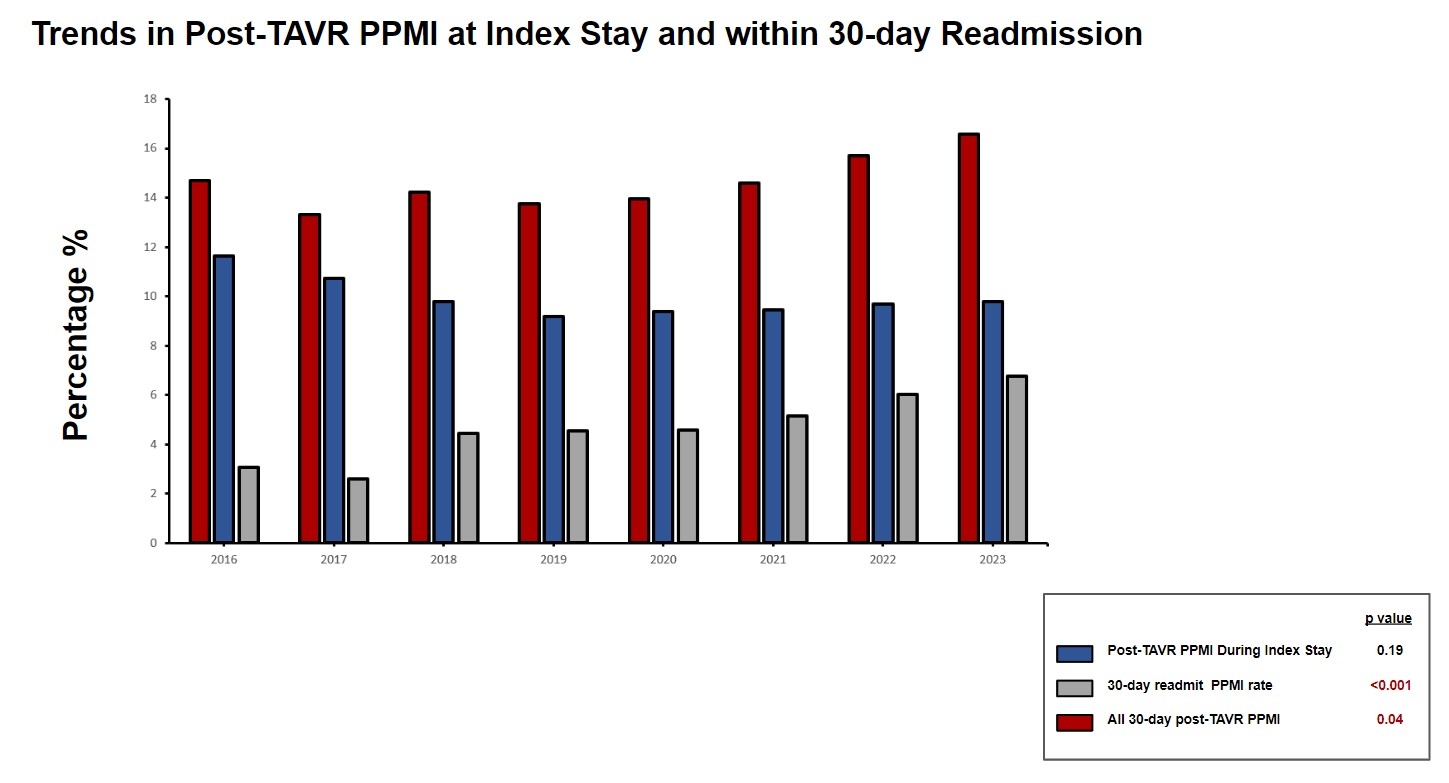
Results Of 253,100 TAVR patients, 24,797 (9.8%) received a PPMI within 30 days. Compared to the non-PPMI group, patients in the PPMI group were of similar age, but were more likely male and White, and had a higher burden of comorbidities. Over the study period, the rate of 30-day post-TAVR PPMI ranged from a low of 13.6% in 2017 to a high of 16.6% in 2023, with an overall increase in trend (p=0.04). With respect to timing of PPMI, the rate of PPMI during index TAVR admission remained similar (p=0.19), while the rate of 30-day readmission for PPMI increased (p<0.001). In tandem, there was a significant trend of shorter hospital length of stay (p< 0.001) across the study period.
Conclusion Despite advancements in TAVR and expansion to lower risk patients during the time period examined, the rate of PPMI within 30 days of TAVR increased, mainly driven by an increase in PPMI after the index hospitalization. Further study is needed to understand the reasons for the observed trends.
Mehta, Chirag
(
Brown University
, Cranston , Rhode Island , United States )
Bhargout, Mohamed
(
Brown University
, Cranston , Rhode Island , United States )
Ahmad, Khansa
(
Brown University
, Cranston , Rhode Island , United States )
Elkaryoni, Ahmed
(
Brown University
, Cranston , Rhode Island , United States )
Imran, Hafiz
(
Brown University
, Cranston , Rhode Island , United States )
Abbott, Jinnette
(
Brown University
, Cranston , Rhode Island , United States )
Sharaf, Barry
(
Brown University
, Cranston , Rhode Island , United States )
Gordon, Paul
(
Brown University
, Cranston , Rhode Island , United States )
Saad, Marwan
(
Brown University
, Providence , Rhode Island , United States )
Author Disclosures:
Chirag Mehta:DO NOT have relevant financial relationships
| Mohamed Bhargout:No Answer
| Khansa Ahmad:No Answer
| Ahmed Elkaryoni:No Answer
| Hafiz Imran:DO NOT have relevant financial relationships
| Jinnette Abbott:DO have relevant financial relationships
;
Consultant:Abbott:Active (exists now)
; Consultant:recor :Active (exists now)
; Research Funding (PI or named investigator):Shockwave:Active (exists now)
; Research Funding (PI or named investigator):Med Allinace:Active (exists now)
; Research Funding (PI or named investigator):Boston Scientific:Active (exists now)
; Consultant:Penumbra:Active (exists now)
; Consultant:Medtronic:Active (exists now)
| Barry Sharaf:No Answer
| Paul Gordon:DO NOT have relevant financial relationships
| Marwan Saad:No Answer