Logo

American Heart Association

  141
  0


Final ID: Mo2049

Leveraging ACHD Patients’ Perceptions of Their Illness to Enhance Patient Engagement and Tailor Provider Care Recommendations

Abstract Body (Do not enter title and authors here): Introduction: Previous research has described barriers and facilitators for adherence to care guidelines among adults with congenital heart disease (CHD). However, uncertainty remains on how to best support patients in clinical practice within time and resource constraints.

Aim: To examine how patients incorporate CHD into their identity and how that influences the management of their condition.

Methods: We conducted 48 semi-structured qualitative interviews with adult CHD patients and providers (cardiologists, nurses, patient coordinators, and social workers). Purposive sampling was used to gain patient diversity in CHD lesions, race/ethnicity, SES, geography, and prior gaps in care. Interviews were conducted by a single interviewer using a semi-structured guide based on the “Capability, Opportunity, Motivation-Behavioral (COM-B)” Framework to explore perceived determinants of behavior for managing CHD and navigating the adult health system. Rapid qualitative analysis was conducted to develop two structured data matrices displaying themes about the influence of CHD on identity and enablers of patient engagement.

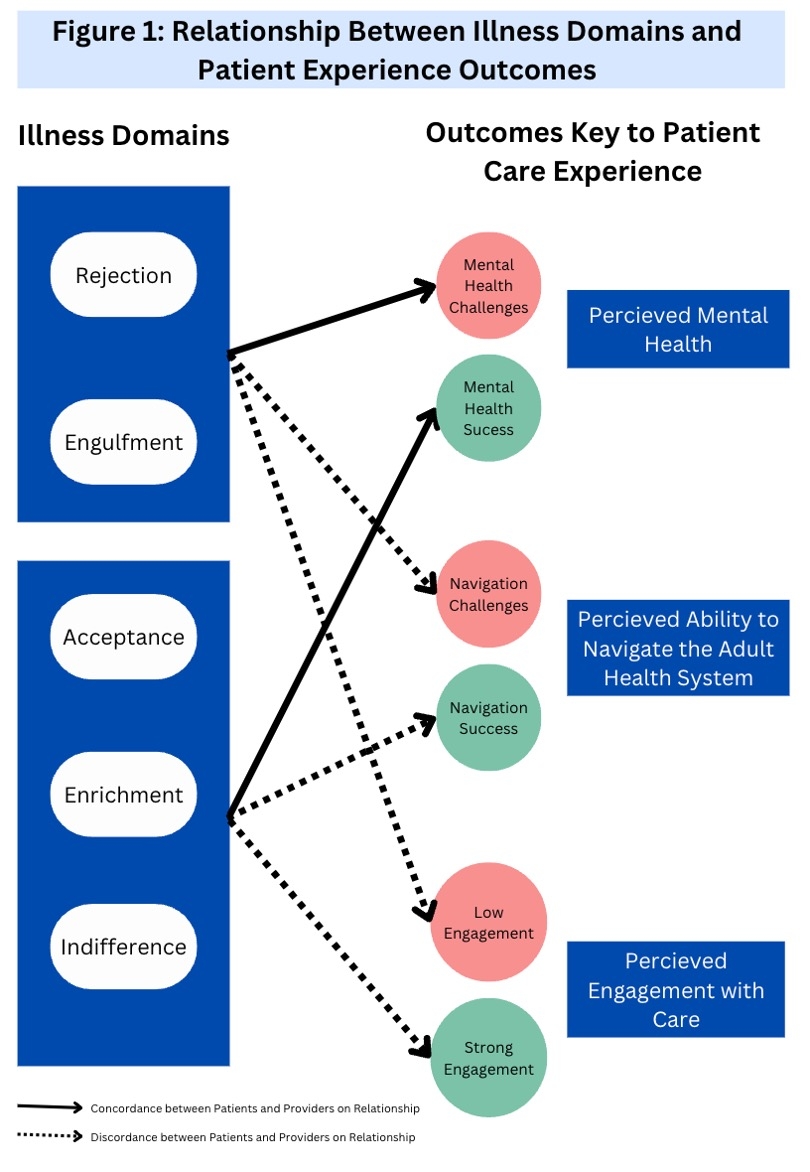
Results: Of 31 patients, 39% were male, 58% were People of Color, and 35% had prior gaps in care (of 3 or more years). Five domains (from 15 themes) emerged to characterize how patients viewed CHD as influencing their ability to engage with care. Themes included 4 Illness Identity domains (Rejection, Acceptance, Engulfment, and Enrichment) and a fifth domain of Indifference - characterized by a lack of emotional valence that accompanies the other four domains. Variance in these domains could be tracked to differences in patient outcomes, such as perceived ability to navigate the healthcare system (Figure 1). Providers and patients demonstrated concordance regarding the perceived influence of illness domains on patients’ mental health but less concordance regarding its impact on patient engagement and healthcare navigation.

Conclusion: Considering the extent to which a patient views their CHD as a component of their identity could help providers support adult CHD patient engagement, tailor counseling about care guidelines, and likely enhance the effectiveness of patient-provider relationships.
  • Macholl, Katelyn  ( USCF , San Francisco , California , United States )
  • Agarwal, Anushree  ( USCF , San Francisco , California , United States )
  • Okumura, Megumi  ( USCF , San Francisco , California , United States )
  • Buenrostro, Karina  ( USCF , San Francisco , California , United States )
  • Mehta, Juhi  ( USCF , San Francisco , California , United States )
  • Sparks, Aleah  ( USCF , San Francisco , California , United States )
  • Ahuja, Pranav  ( USCF , San Francisco , California , United States )
  • Sun, Kevin  ( USCF , San Francisco , California , United States )
  • Dohan, Daniel  ( USCF , San Francisco , California , United States )
  • Gurvitz, Michelle  ( Boston Childrens Hospital , Boston , Massachusetts , United States )
  • Author Disclosures:
    Katelyn Macholl: DO NOT have relevant financial relationships | Anushree Agarwal: DO NOT have relevant financial relationships | megumi okumura: DO NOT have relevant financial relationships | Karina Buenrostro: No Answer | Juhi Mehta: DO NOT have relevant financial relationships | Aleah Sparks: No Answer | Pranav Ahuja: DO NOT have relevant financial relationships | Kevin Sun: No Answer | Daniel Dohan: DO NOT have relevant financial relationships | Michelle Gurvitz: DO NOT have relevant financial relationships
Meeting Info:

Scientific Sessions 2024

2024

Chicago, Illinois

Session Info:

Adult Congenital Heart Disease

Monday, 11/18/2024 , 01:30PM - 02:30PM

Abstract Poster Session

More abstracts on this topic:
Digital Health Intervention to Enhance Optimization of Heart Failure Care: From Reciprocal Innovation using Human-Centered Design to Pilot Study

Polachini Beatriz, Beaton Andrea, Longenecker Chris, Ribeiro Antonio Luiz, Brant Luisa, Ciminelli Ana Luiza, Lino Rafael, Bramucci Victoria, Ribeiro Edmar, Rezende Lilian, Spaulding Erin, Sandhu Alexander, Azizi Zahra

Aerobic Capacity of Adults with Fontan Palliation: Disease-specific Reference Values and Relationship to Outcomes

Ali Ahmed, Goda Ahmed, Abozied Omar, Egbe Alexander

More abstracts from these authors:

The Impact of Race/Ethnicity, Education, and Income on Patient Engagement in Adult Congenital Heart Disease Care

Sandoval Rivera Andrea, Moons Philip, Okumura Megumi, Gurvitz Michelle, Agarwal Anushree, Valente Joseph, Banala Keerthana Reddy, Duan Rong, Alano Lindsay, Parang Kim, Bravo-jaimes Katia, Norris Mark, Reardon Leigh

Understanding the association between patient empowerment level and patient-prioritized education topics in adult congenital patient population: A descriptive cross-sectional study

Banala Keerthana Reddy, Moons Philip, Okumura Megumi, Gurvitz Michelle, Agarwal Anushree, Valente Joseph, Sandoval Rivera Andrea, Duan Rong, Alano Lindsay, Parang Kim, Bravo-jaimes Katia, Norris Mark, Reardon Leigh

You have to be authorized to contact abstract author. Please, Login
Not Available