
Logo

American Heart Association

  113
  0


Final ID: MDP1270

The technique of permanent pericardial catheter in mice

Abstract Body (Do not enter title and authors here): Background
Intrapericardial delivery of bioactive compounds, drugs, genes, and stem cells shows promise in bypassing the limitations of traditional administration routes for heart therapeutics. However, the mouse heart's size and pericardial membrane thickness pose challenges for catheterization. The absence of a reproducible technique for pericardial catheter placement in mice hinders the development of therapies targeting the pericardial space.
Research Question
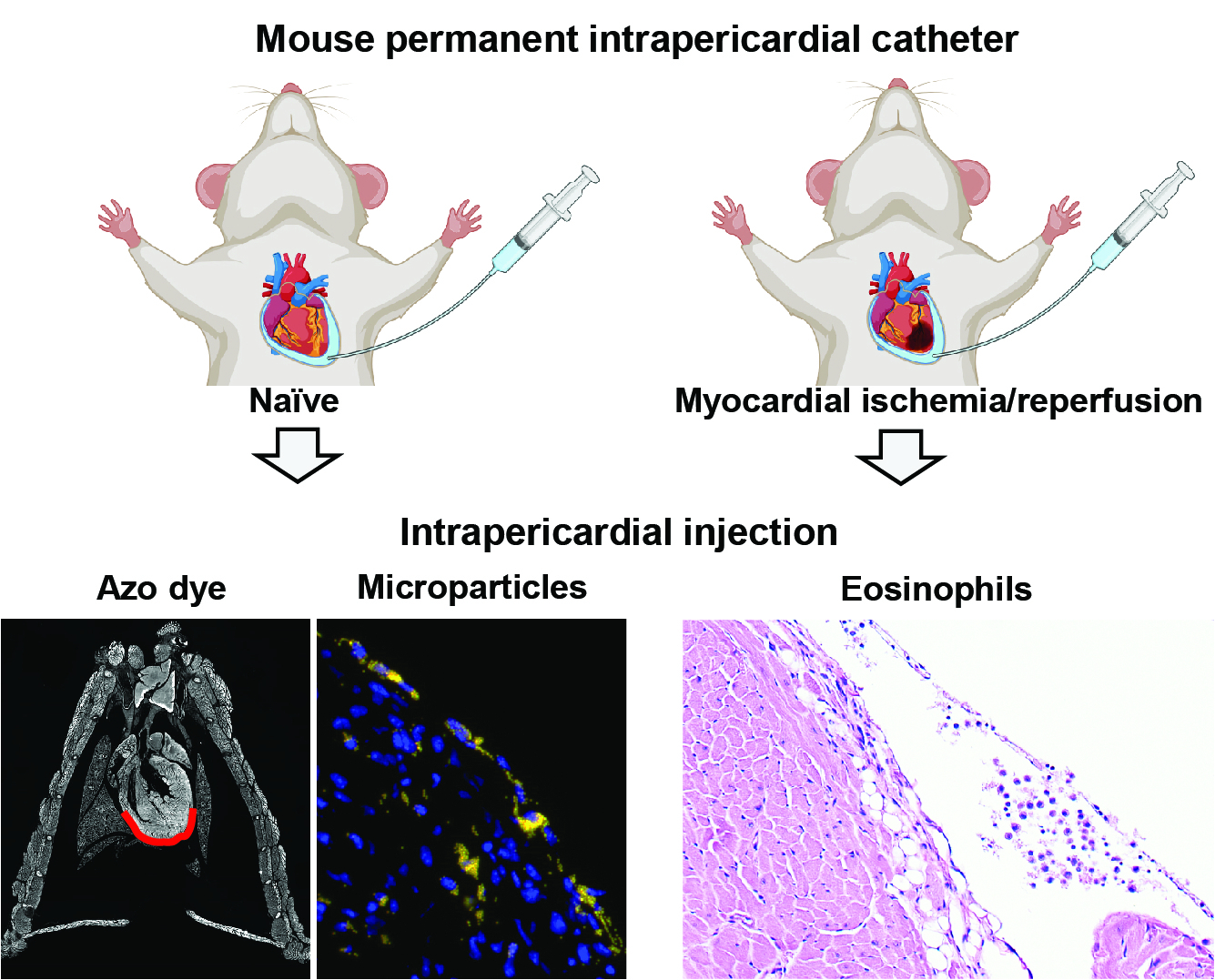
This study aimed to develop a surgical technique for permanent pericardial catheter insertion in mice and evaluate its feasibility for intrapericardial delivery of therapeutic agents alone and in combination with a closed-chest mouse model of myocardial ischemia/reperfusion (I/R).
Methods
Anesthetized mice underwent thoracotomy, followed by microcatheter insertion into the pericardial space through the intercostal space. The catheter was secured under the skin for subsequent intrapericardial injections. The technique was validated using fluorescent beads. Pericardial catheter implantation was then combined with a closed-chest myocardial I/R by placing an occluder on the left anterior descending coronary artery. Flow cytometry, fluorescent microscopy, and histological assessments were conducted to analyze outcomes.
Results
We successfully developed a surgical technique for pericardial catheter insertion in mice. All the animals survived the procedure and showed no complications during the recovery period. The implanted catheters enabled intrapericardial delivery of azo dye, fluorescent beads, and eosinophils. Additionally, we demonstrated the combination of pericardial catheterization with the closed-chest model of myocardial I/R.
Conclusion
The developed surgical approach enables the placement of the permanent pericardial catheter in mice for intrapericardial delivery of therapeutic agents. The technique is reproducible and provides a valuable tool for studying the pericardial space and mediastinum in basic and translational research. The combination of pericardial catheterization with the myocardial I/R model allows for the investigation of intrapericardial delivery following myocardial infarction.
  • Rusinkevich, Vitali  ( Children's Hospital of Philadelphia , Philadelphia , Pennsylvania , United States )
  • Elias, David  ( The Johns Hopkins University School of Medicine , Baltimore , Maryland , United States )
  • Talor, Monica  ( The Johns Hopkins University School of Medicine , Baltimore , Maryland , United States )
  • Cihakova, Daniela  ( The Johns Hopkins University School of Medicine , Baltimore , Maryland , United States )
  • Author Disclosures:
    Vitali Rusinkevich: DO NOT have relevant financial relationships | David Elias: No Answer | Monica Talor: No Answer | Daniela Cihakova: No Answer
Meeting Info:

Scientific Sessions 2024

2024

Chicago, Illinois

Session Info:

Novel Approaches and New Models for Cardiovascular Research

Monday, 11/18/2024 , 11:10AM - 12:40PM

Moderated Digital Poster Session

More abstracts on this topic:
A Potential Role for NKG2D, an NK cell receptor, in Accelerated CVD risk in African American Women Living in More Adverse Neighborhood Conditions: Data From the Step It Up Physical Activity Digital Health-Enabled, Community-Engaged Intervention

Baez Andrew, Andrews Marcus, Sandler Dana, Aquino Peterson Elizabeth, Sharda Sonal, Tolentino Katherine Joy, Lopez De Leon Shirley, Seo Jein Eleanor, Cintron Manuel, Pita Mario, Tarfa Hannatu, Baumer Yvonne, Reger Robert, Childs Richard, Powell-wiley Tiffany, Dave Ayushi, Saurabh Abhinav, Mendelsohnl Laurel, Chen Long, Igboko Muna, Wells Ayanna, Marah Marie

Controlled Release of Interleukin-10 Effectively Programs Macrophage Phenotypes and Cardiac Remodeling

Zhang Jing, Kim Kang, Huard Johnny, Wang Yadong, Chen William Cw

More abstracts from these authors:
Inhibiting IL-1 Signaling to Cardiac Fibroblasts Protects Against Acute Viral Myocarditis

Elias David, Jo Wonyoung, Talor Monica, Cihakova Daniela

The Role of Intracellular IL-33 in Dilated Cardiomyopathy

Jaime Camille, Talor Monica, Cihakova Daniela

You have to be authorized to contact abstract author. Please, Login
Not Available