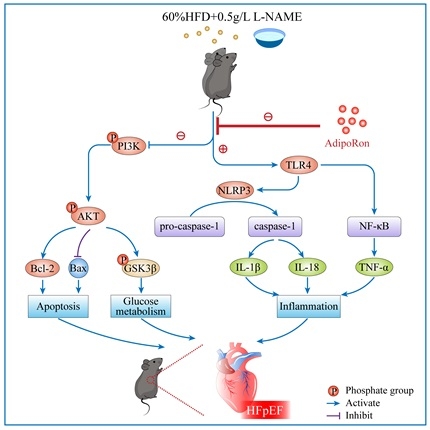
Adiponectin receptor agonist alleviates heart failure with preserved ejection fraction by regulating NLRP3/Caspase-1/IL-1β and Pl3K/Akt signaling pathway
Abstract Body (Do not enter title and authors here): Background: Treating and managing heart failure with preserved ejection fraction (HFpEF) remains challenging. With the gradual increase in the number of obese individuals, diabetics, and cases of hypertension, HFpEF prevalence accounts for half of the total number of patients with heart failure. HFpEF, for which no specific treatment exists, is the most challenging problem. Objective: To investigate the cardioprotective effects and mechanisms of an adiponectin receptor agonist, AdipoRon, as an anti-inflammatory agent in a two-hit HFpEF mice model. Methods: A mouse model of HFpEF was induced using a 60% high-fat diet plus 5.0g/L L-NAME drinking water for 12 weeks. AdipoRon (50 mg/kg) or a comparable volume of saline via gavage once daily was administered to the two-hit HFpEF mice model for four weeks. Cardiac function was evaluated by echocardiography, while molecular biology techniques were employed to determine the effect of AdipoRon. Results: The oral adiponectin receptor agonist, AdipoRon, inhibited HFpEF inflammation by downregulating NLRP3, caspase-1, IL-1β and IL-18, and suppressing the TLR4/NF-κB/TNF-α signaling pathway. This improved cardiac functional phenotypes, including cardiac diastolic dysfunction, pulmonary congestion, myocardial hypertrophy, reduced exercise tolerance, and glucose intolerance. AdipoRon improved heart rate variability (HRV) , decreased serum norepinephrine(NE), which inhibiting inflammation-induced cardiac sympathetic over-activation. AdipoRon dramatically reversed HFpEF-induced down-regulation of PI3K, Akt, and GSK3β phosphorylation, improved glucose metabolism and attenuated the cardiac damage associated with glucose accumulation. Our findings indicated AdipoRon’s ability to downregulate the expression of Bax/Bcl-2, inhibiting cardiomyocyte apoptosis, attenuating myocardial injury, and effectively improving cardiac function and ventricular remodeling. Conclusion: AdipoRon attenuated inflammatory response, improved cardiac function and phenotypes, and ameliorated impaired myocardial glucose metabolism and apoptosis in HFpEF mice. This was achieved by modulation of NLRP3/Caspase-1/IL-1β, Pl3K/Akt, and TLR4/NF-κB/TNF-α signaling pathways.
Cheng, Siyi
(
Department of Cardiology, Renmin Hospital of Wuhan University; Hubei Key Laboratory of Autonomic Nervous System Modulation
, Wuhan , China )
Yu, Lilei
(
Department of Cardiology, Renmin Hospital of Wuhan University; Hubei Key Laboratory of Autonomic Nervous System Modulation
, Wuhan , China )
Zhou, Xiaoya
(
Department of Cardiology, Renmin Hospital of Wuhan University; Hubei Key Laboratory of Autonomic Nervous System Modulation
, Wuhan , China )
Author Disclosures:
Siyi Cheng:No Answer
| Lilei Yu:DO NOT have relevant financial relationships
| Xiaoya Zhou:No Answer