
Costs and Healthcare Resource Utilization in Transthyretin Amyloid Cardiomyopathy Exceeds That of Non-amyloid Heart Failure
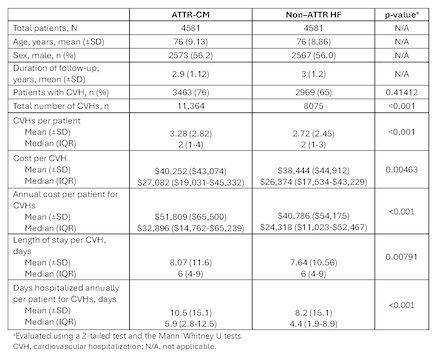
Abstract Body (Do not enter title and authors here): Background: Transthyretin amyloid cardiomyopathy (ATTR-CM) is a progressive, fatal condition characterized by worsening heart failure (HF), exercise intolerance, cardiac arrhythmias, aortic stenosis, and orthopedic manifestations. Recent analyses have shown ATTR-CM presents a significant burden to the healthcare system, but data on healthcare resource utilization (HCRU) comparing ATTR-CM to non-ATTR HF in the US are lacking. Aim: To compare HCRU and costs in patients (pts) with ATTR-CM to that of pts with non-ATTR HF using medical and pharmacy claims. Methods: Using the Optum Clinformatics Data Mart (Jan 2016-Sep 2023), pts with ATTR-CM were identified based on presence of HF and/or cardiomyopathy (CM) occurring within 2 years of first amyloidosis diagnosis (excluding light-chain amyloidosis) and followed for at least 12 months after first HF/CM diagnosis. ATTR-CM pts were matched 1:1 to non-ATTR HF pts using propensity score matching. After index diagnosis, both groups were assessed for HCRU, including inpatient acute cardiovascular (CV) hospitalizations (CVH), length of stay, and cost. Hospitalizations were considered CV if a pt received a CV diagnosis during the hospitalization period. Results: There were 4581 pts with ATTR-CM (mean [±SD] age: 76 [9.13] years; 56.2% male) who met inclusion criteria and were matched to 4581 non-ATTR HF pts (mean [±SD] age: 76 [8.86] years; 56.0% male) for comparison (Table). ATTR-CM pts had a higher trend of CVH and a higher number of total CVHs and mean hospitalizations per pt compared to non-ATTR HF pts (p<0.001). The mean cost per hospitalization (p=0.00463) and mean cost per annual hospitalizations per pt (p<0.001) were higher for ATTR-CM compared to non-ATTR HF. ATTR-CM pts were also hospitalized for more mean days annually for CV-related reasons compared to non-ATTR HF pts (p<0.001). On average, pts with ATTR-CM spent 2.3 days more than matched non-ATTR HF pts in the hospital each year. Conclusion: Compared to non-ATTR HF, ATTR-CM is associated with a greater burden on the healthcare system as evaluated by hospitalization rate, costs per hospitalization, annual hospitalization costs, and days hospitalized annually.
Grodin, Justin
(
UT SOUTHWESTERN
, Dallas , Texas , United States )
Masri, Ahmad
(
OHSU
, Portland , Oregon , United States )
Wright, Richard
(
PACIFIC HEART INSTITUTE
, Santa Monica , California , United States )
Tamby, Jean-francois
(
BridgeBio Pharma
, San Francisco , California , United States )
Falvey, Heather
(
BridgeBio Pharma
, San Francisco , California , United States )
Hennum, Liana
(
BridgeBio Pharma
, San Francisco , California , United States )
Badwe, Chaitanya
(
Definitive Healthcare
, New York , New York , United States )
Allison, Melissa
(
Definitive Healthcare
, New York , New York , United States )