Reducing the Risks of Complex Pediatric Cardiovascular Surgery using Glucagon-Like Peptide 1 Peptides
Abstract Body (Do not enter title and authors here): Background: Children with critical congenital heart disease (CHD) often require complex open-heart surgery with long aortic cross-clamp times (XC). Despite refinement in cardioplegia, ventricular dysfunction due to inadequate myocardial protection remains a major clinical challenge. Glucagon-like peptide-1 (GLP-1) has proven cardioprotective properties. This study characterizes the mechanisms of injury of long XC and investigates cardioprotective properties of GLP-1(28-36), a naturally occurring fragment of GLP-1.
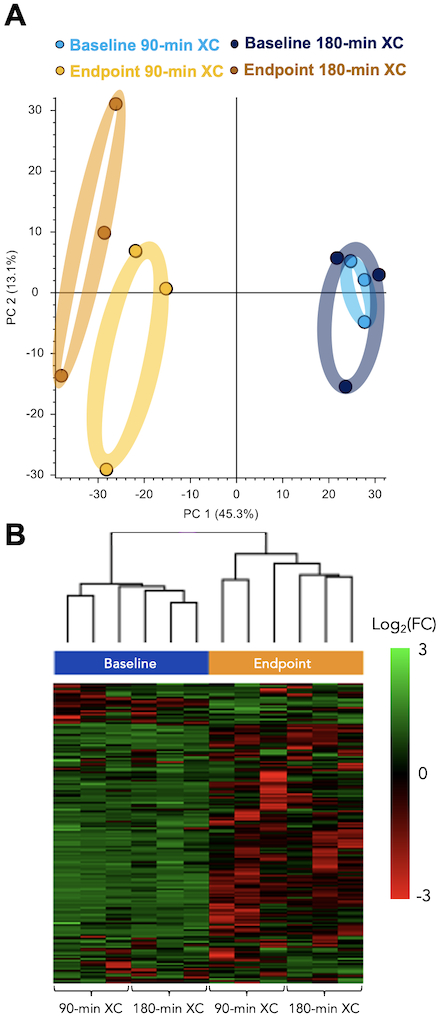
Method & Results: A pediatric surgical model of cardiopulmonary bypass and long XC was developed in 4-5 wk-old Yorkshire pigs. Pigs were subjected to 90-min XC (modelling common CHD repair, e.g. Tetralogy of Fallot) or 180-min XC (modelling complex CHD repair, e.g. corrected transposition). After 90-min XC [n=8], analysis of cardiac function at baseline vs. 2-h post-bypass revealed reduced ejection fraction (55±6% vs. 28±4%; P<0.001) and global longitudinal strain (-11.5±1.5% vs. -6.8±1.2%; P<0.001). Levels of arterial lactate (0.6±0.1 vs. 3.9±0.8 mmol/L; P<0.001), myeloperoxidase (MPO: 39±4 vs. 124±28 ng/mL; P<0.001) and cardiac Troponin-I (cTnI: 0.01±0.01 vs. 4.8±0.6 ng/mL; P<0.001) indicate metabolic- and oxidative-stress and cardiomyocyte injury. Markedly reduced survival after 180- vs. 90-min XC (37.5% vs. 100% survival; n=8/group, P<0.05) was accompanied by more profound cardiac dysfunction, metabolic- and oxidative-stress, and cardiomyocyte injury in pigs surviving 180-min XC. Untargeted plasma metabolomics reveal XC time-dependent signatures (Figure 1). Adding GLP-1(28-36) vs. control SCRAM(28-36) [30nM; n=8/group] to cardioplegia during 90-min XC caused longer time to first heart beat following XC (165±21 vs. 59±7 sec; P<0.001), with markedly reduced oxidative stress (MPO: 74±19 vs. 131±30 ng/mL; P<0.01) and cardiomyocyte injury (cTnI: 1.9±0.4 vs. 5.1±0.7 ng/mL; P<0.001).
Conclusions: In a new model of long XC designed to simulate pediatric surgical repair of common and complex CHD, we demonstrate time-dependent cardiac dysfunction correlating with metabolic- and oxidative-stress and cardiomyocyte injury. Treatment with GLP-1(28-36) reduced injury and may mediate this by inducing hibernation.
Lao, Robert
( University of Toronto
, Toronto
, Ontario
, Canada
)
Friedberg, Mark
( The Hospital for Sick Children
, Toronto
, Ontario
, Canada
)
Husain, Mansoor
( University Health Network
, Toronto
, Ontario
, Canada
)
Honjo, Osami
( The Hospital for Sick Children
, Toronto
, Ontario
, Canada
)
Kobayashi, Yasuyuki
( The Hospital for Sick Children
, Toronto
, Ontario
, Canada
)
Stanisic, Anamaria
( The Hospital for Sick Children
, Toronto
, Ontario
, Canada
)
Hui, Wei
( The Hospital for Sick Children
, Toronto
, Ontario
, Canada
)
Deng, Mimi
( University of Toronto
, Toronto
, Ontario
, Canada
)
Kadowaki, Sachiko
( The Hospital for Sick Children
, Toronto
, Ontario
, Canada
)
Siraj, M. Ahsan
( University Health Network
, Toronto
, Ontario
, Canada
)
Lamba, Manya
( University of Toronto
, Toronto
, Ontario
, Canada
)
Li, Jing
( The Hospital for Sick Children
, Toronto
, Ontario
, Canada
)
Author Disclosures:
Robert Lao:DO NOT have relevant financial relationships
| Mark Friedberg:No Answer
| Mansoor Husain:No Answer
| Osami Honjo:DO NOT have relevant financial relationships
| Yasuyuki Kobayashi:DO NOT have relevant financial relationships
| Anamaria Stanisic:No Answer
| Wei Hui:No Answer
| Mimi Deng:DO NOT have relevant financial relationships
| Sachiko Kadowaki:DO NOT have relevant financial relationships
| M. Ahsan Siraj:DO NOT have relevant financial relationships
| Manya Lamba:DO NOT have relevant financial relationships
| Jing Li:No Answer