
Logo

American Heart Association

  102
  0


Final ID: MDP15

Cross-species single-cell RNA sequencing reveals divergent phenotypes and activation states of adaptive immunity in human carotid and experimental murine atherosclerosis

Abstract Body (Do not enter title and authors here): Background and Aims: The distinct functions of immune cells in atherosclerosis have been mostly defined by preclinical mouse studies. Contrastingly, the immune cell composition of human atherosclerotic plaques and their contribution to disease progression is only poorly understood. It remains uncertain whether genetic animal models allow for valuable translational approaches.
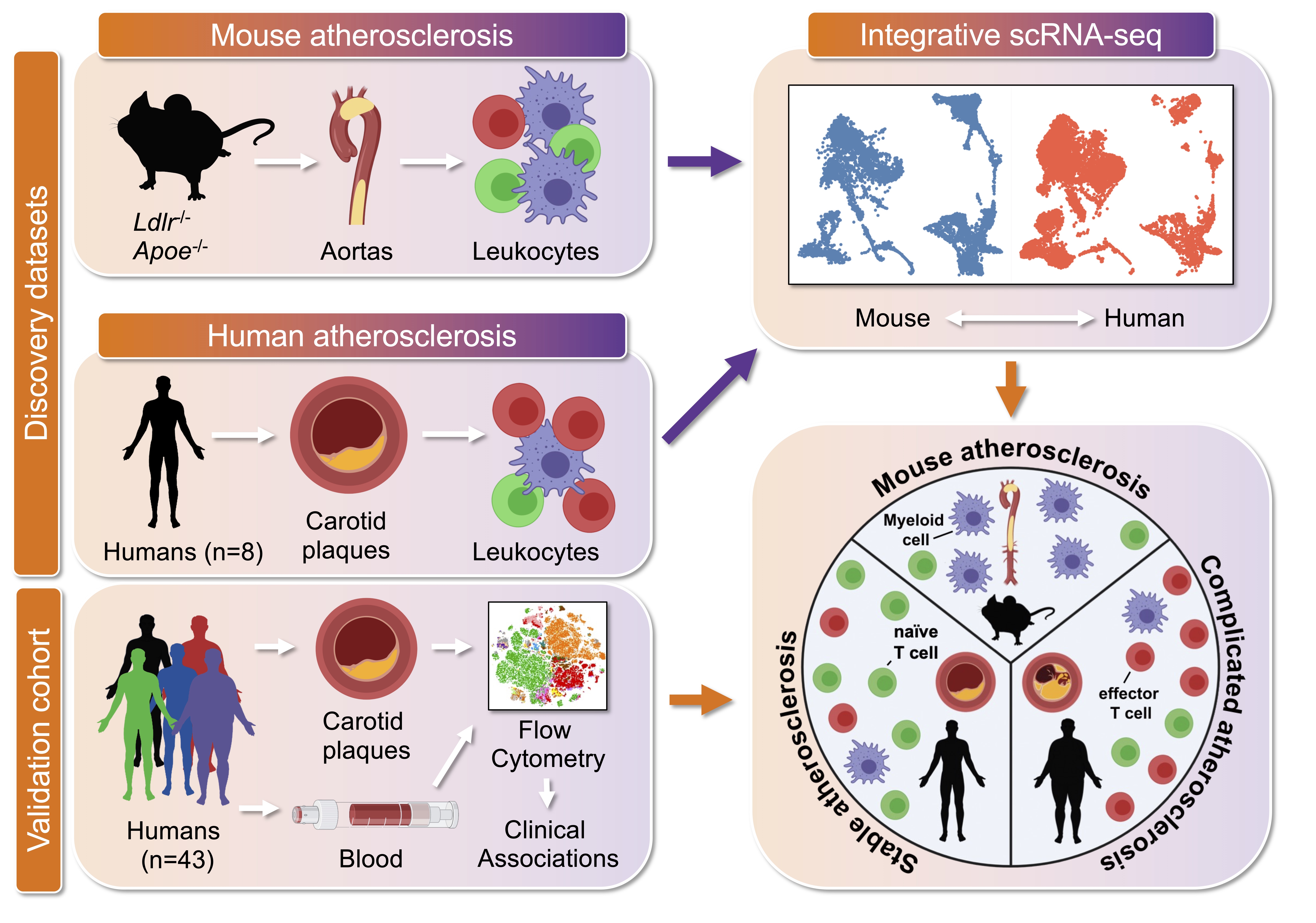
Methods and Results: Single cell RNA-sequencing (scRNA-seq) was performed to define the immune cell landscape in human carotid atherosclerotic plaques. The human immune cell repertoire demonstrated an unexpectedly high heterogeneity and was dominated by cells of the T-cell lineage, a finding confirmed by immunohistochemistry. Bioinformatical integration with 7 mouse scRNA-seq data sets from adventitial and atherosclerotic vascular tissue revealed a total of 51 identities of cell types and differentiation states, of which some were only poorly conserved between species and exclusively found in humans. Locations, frequencies, and transcriptional programs of immune cells in mouse models did not resemble the immune cell landscape in human carotid atherosclerosis. In contrast to standard mouse models of atherosclerosis, human plaque leukocytes were dominated by several T-cell phenotypes with transcriptional hallmarks of T-cell activation and memory formation, T-cell receptor-, and pro-inflammatory signaling. Only mice at the age of 22 months partially resembled the activated T-cell phenotype. In a validation cohort of 43 patients undergoing carotid endarterectomy, the abundance of activated immune cell subsets in the plaque defined by multi-color flow cytometry associated with the extend of clinical atherosclerosis.
Conclusions: Integrative scRNA-seq reveals a substantial difference in the immune cell composition of murine and human carotid atherosclerosis – a finding that questions the translational value of standard mouse models for adaptive immune cell studies. Clinical associations suggest a specific role for T-cell driven (auto-) immunity in human plaque formation and -instability.
  • Horstmann, Hauke  ( NYU Langoen Hospital , New York , New York , United States )
  • Westermann, Dirk  ( UHZ Freiburg Bad Krozingen , Freiburg , Germany )
  • Zirlik, Andreas  ( Medical University Graz , Graz , Austria )
  • Wolf, Dennis  ( UHZ Freiburg Bad Krozingen , Freiburg , Germany )
  • Anto-michel, Nathaly  ( Medical University of Graz , Graz , Austria )
  • Sheng, Xia  ( UHZ Freiburg Bad Krozingen , Freiburg , Germany )
  • Winkels, Holger  ( University of Cologne , Cologne , Germany )
  • Hilgendorf, Ingo  ( UHZ Freiburg Bad Krozingen , Freiburg , Germany )
  • Gerhardt, Teresa  ( Mount Sinai , New York , New York , United States )
  • Zernecke, Alma  ( University of Würzburg , Würzburg , Germany )
  • Kohl, Peter  ( UNIVERSITY OF FREIBURG , Freiburg , Germany )
  • Foks, Amanda  ( Leiden University , Leiden , Netherlands )
  • Author Disclosures:
    Hauke Horstmann: DO NOT have relevant financial relationships | Dirk Westermann: No Answer | Andreas Zirlik: DO NOT have relevant financial relationships | Dennis Wolf: No Answer | Nathaly Anto-Michel: No Answer | Xia Sheng: DO NOT have relevant financial relationships | Holger Winkels: DO NOT have relevant financial relationships | Ingo Hilgendorf: No Answer | Teresa Gerhardt: No Answer | Alma Zernecke: No Answer | Peter Kohl: DO NOT have relevant financial relationships | Amanda Foks: DO NOT have relevant financial relationships
Meeting Info:

Scientific Sessions 2024

2024

Chicago, Illinois

Session Info:

Lipids are Prominent Influencers of Immune Cell Function

Saturday, 11/16/2024 , 11:10AM - 12:25PM

Moderated Digital Poster Session

More abstracts on this topic:
β1-adrenergic autoantibodies (β1-AA) augment macropinocytosis in CD4+ T cells, leading to the expansion of CD4+CD28 T cell subsets in heart failure.

Sun Fei, Yao Junyan, Li Bingjie, Zhang Suli, Liu Huirong

A major uremic toxin indoxyl sulfate impairs macrophage efferocytosis and accelerates atherogenesis: a potential mechanism for cardiovascular risk in chronic kidney disease

Jha Prabhash, Kasai Taku, Vromman Amelie, Holden Rachel, Libby Peter, Tabas Ira, Singh Sasha, Aikawa Elena, Aikawa Masanori, Lupieri Adrien, Sonawane Abhijeet, Le Thanh-dat, Becker-greene Dakota, Chelvanambi Sarvesh, Turner Mandy, Nakamura Yuto, Passos Livia

More abstracts from these authors:
Protein Arginin Deiminase 4 Deficiency Prevents Streptozotocin-induced Diabetic Cardiomyopathy and Heart Failure with Reduced NLRP3 (Nucleotide-Binding Domain-Like Receptor Protein 3) Inflammasome Activation

Schommer Nicolas, Sheehy Casey, Van Bruggen Stijn, Jarrot Pierre-andré, Chan William, Westermann Dirk, Wagner Denisa, Heger Lukas

Neutrophil NLRP3 Inflammasome Aggravates Cardiac Injury Following Myocardial Infarction through Interleukin-1β, von Willebrand Factor, and Neutrophil Extracellular Traps

Schommer Nicolas, Heger Lukas, Van Bruggen Stijn, Sheehy Casey, Chan William, Jarrot Pierre-andré, Westermann Dirk, Wagner Denisa

You have to be authorized to contact abstract author. Please, Login
Not Available