Machine Learning Predicts 24-Hour Change in Decongestion Biomarkers in Hospitalized Heart Failure Patients
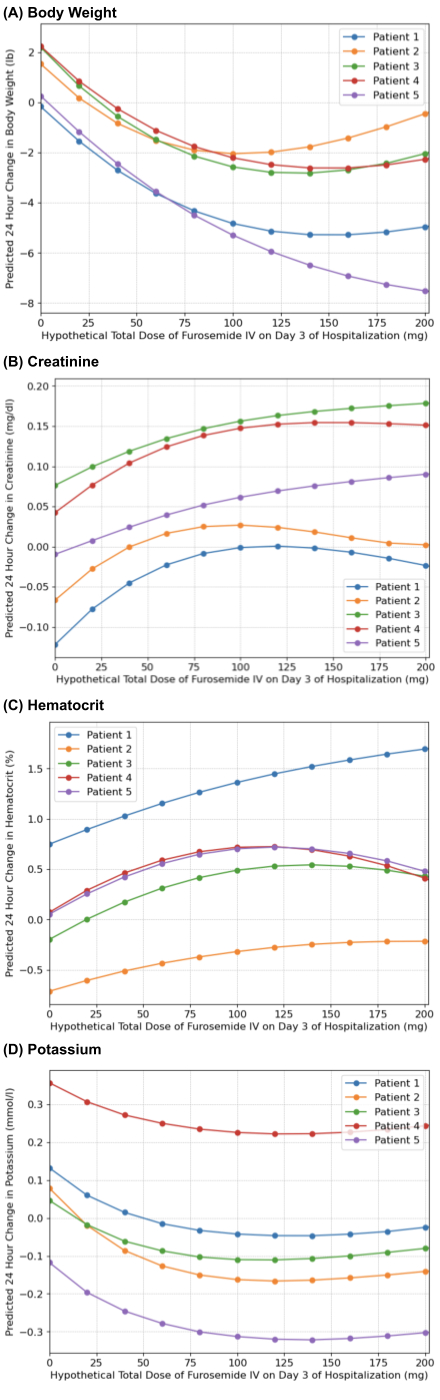
Abstract Body (Do not enter title and authors here): Background: Despite recent advances, patients with heart failure (HF) often experience repeat hospitalizations and worsening clinical trajectories from inadequate decongestion. Evidence-based approaches for optimizing interventions in the acute hospital setting for patients with decompensated HF are needed. We evaluated whether machine learning (ML) models can accurately predict next-day levels for decongestion surrogates in hospitalized HF patients. Hypothesis: ML can accurately predict body weight, hematocrit, creatinine, and potassium values in the next 24 hours in hospitalized HF patients. Methods: We utilized national Veterans Affairs (VA) databases to study all patients admitted with HF from January 2014 to July 2022. Records including at least one value for at least one biomarker of interest (body weight, hematocrit, creatinine, and potassium) were included. Patients were randomly split into training (80%), validation (10%), and test (10%) datasets. We trained a recurrent neural network to predict each biomarker’s value on admission day n+1 using data until day n, simulating a scenario where a clinician monitors response to treatment (e.g., diuresis) over a 24-hour cycle. The model that performed best on the validation set was evaluated on the test set. The R2, mean absolute error (MAE), and feature importance were determined. Results: We identified 589,114 admissions involving 124,163 unique patients. The mean (SD) age on admission was 72 (10) years; 98% were male, 69% were white, and 25% were Black. The performance (R2, MAE) for each biomarker model was as follows: body weight (0.94, 6.15 lb.), creatinine (0.92, 0.21 mg/dL), hematocrit (0.86, 1.7%), and potassium (0.53, 0.27 mmol/L). The top predictive features across all models were intravenous or oral diuretic use, patient age, and diastolic blood pressure. The predicted 24-hour change in each biomarker based on total daily diuretic dose for five representative patients is demonstrated in the Figure. Conclusions: ML can accurately predict the 24-hour body weight, hematocrit, creatinine, and potassium values in hospitalized HF patients, suggesting the potential for AI to guide acute in-hospital management.
Harzand, Arash
(
Atlanta VA Medical Center
, Decatur , Georgia , United States )
Vremenko, Dmytro
(
Empallo
, Boston , Massachusetts , United States )
Wilcox, Alexander
(
Empallo
, Boston , Massachusetts , United States )
Beskin, Claire
(
Empallo
, Boston , Massachusetts , United States )
Liao, Ruizhi
(
Empallo
, Boston , Massachusetts , United States )
Joseph, Jacob
(
VA PROVIDENCE HEALTHCARE, BROWN U.
, Providence , Massachusetts , United States )
Author Disclosures:
Arash Harzand:DO have relevant financial relationships
;
Consultant:Moving Analytics/Movn Health:Past (completed)
; Individual Stocks/Stock Options:Moving Analytics/Movn Health:Active (exists now)
| Dmytro Vremenko:No Answer
| Alexander Wilcox:DO NOT have relevant financial relationships
| Claire Beskin:DO have relevant financial relationships
;
Ownership Interest:Empallo:Active (exists now)
; Employee:Empallo:Active (exists now)
| Ruizhi Liao:No Answer
| Jacob Joseph:DO have relevant financial relationships
;
Research Funding (PI or named investigator):Kowa Pharmaceuticals:Past (completed)
; Research Funding (PI or named investigator):Alnylam:Active (exists now)