
Association Between the Severity of Coronary Artery Stenosis with the Minimum Responsive Dose of Intracoronary Acetylcholine Provocation Test
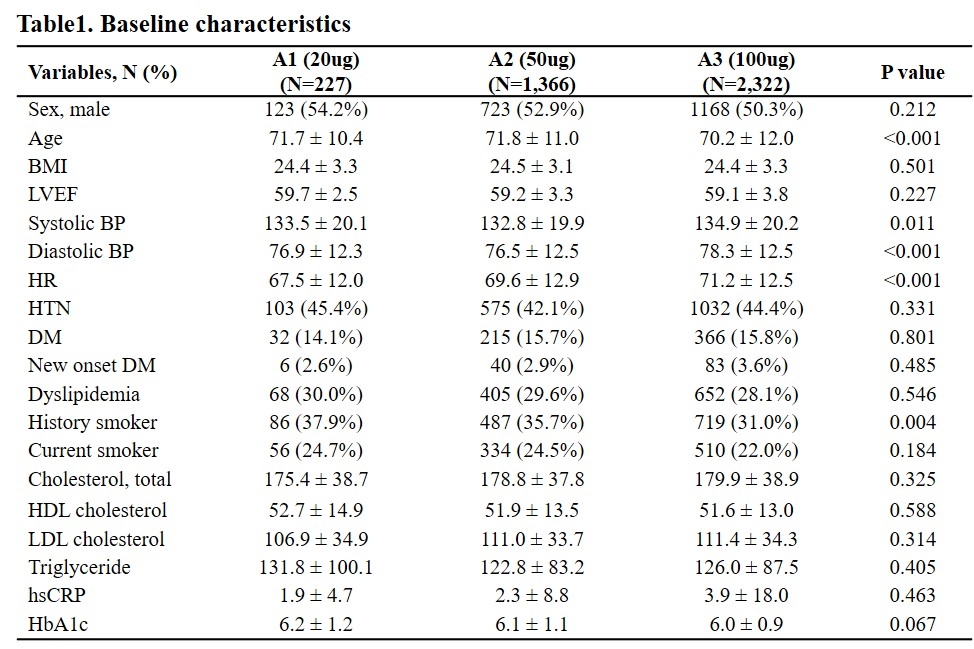
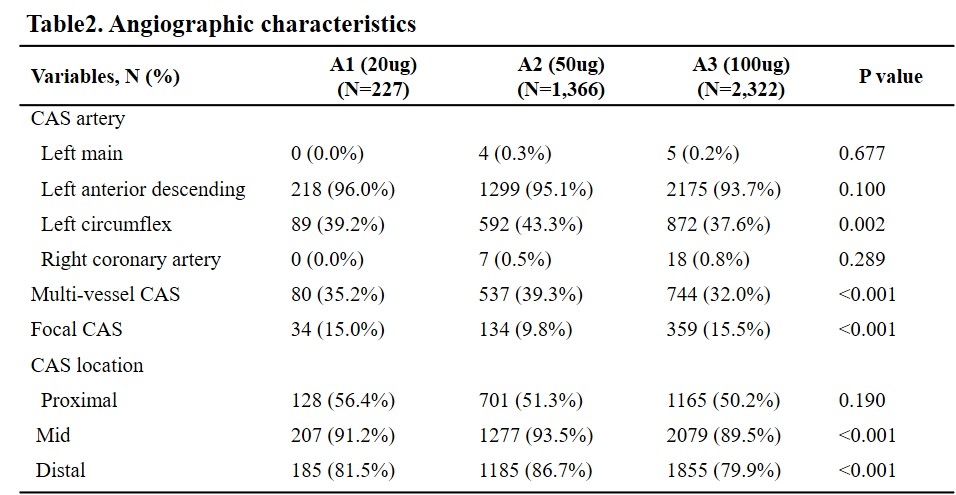
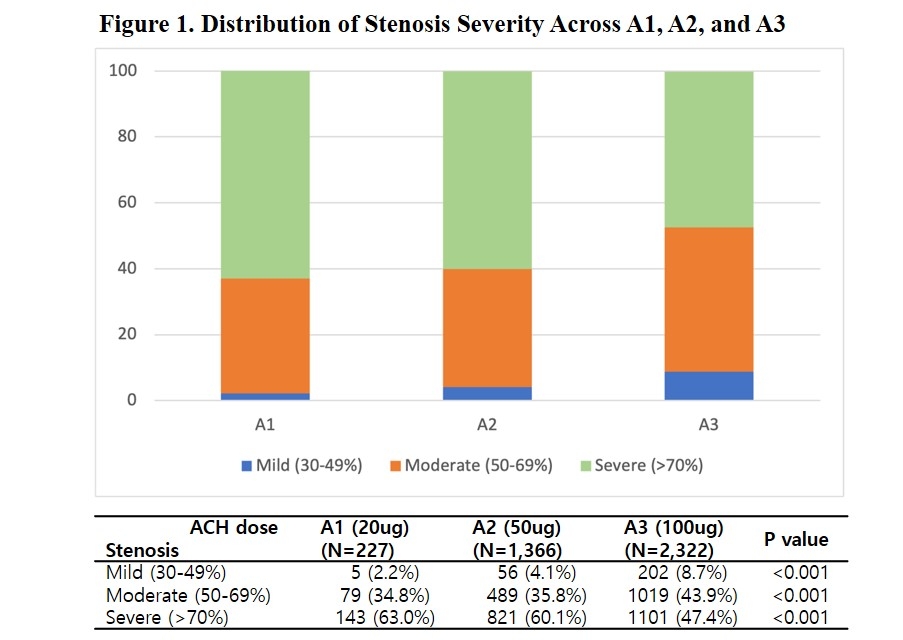
Abstract Body (Do not enter title and authors here): BACKGROUND: Coronary artery spasm (CAS) is a cause of variant angina and is typically diagnosed by intracoronary acetylcholine (ACH) provocation test. Investigations regarding association between the severity of coronary artery stenosis and the minimum responsive dose of ACH required for provocation is limited. METHODS: In this study, 3,915 patients who underwent the acetylcholine (ACH) provocation test and showed CAS between October 2004 and December 2022 were enrolled. Significant CAS was defined as temporary narrowing of ≥70% during the ACH test. Patients were divided into three groups, based on the minimum responsive dose of ACH: A1 group (20ug, n=227), A2 group (50ug, n=1,366) and A3 group (100ug, n=2,322). RESULTS: In patients who were documented with positive intracoronary ACH provocation test, 5.8% responded at the lowest dose (20ug), 34.9% responded at the medium doses (50ug) and 59.3% responded only at the highest dose of ACH (100ug). The baseline characteristics of the patients among the 3 groups were similar, demonstrating no significant difference in the prevalence of hypertension, diabetes mellitus, and dyslipidemia. However, patients who responded at lower dose showed higher proportion of smokers (A1 37.9% vs. A2 35.7% vs. A3 31.0%, p=0.004). A1 group demonstrated the highest proportion of severe stenosis (63.0%), followed by A2 group (60.1%) and A3 group (47.4%) (Figure 1). CONCLUSION: In patients with chest pain with positive intracoronary ACH provocation test, severe stenotic lesions were found to be more frequent and more susceptible in patients who responded at lower doses of ACH.
Rha, Seung-woon
(
Korea University Guro Hospital
, Seoul , Korea (the Republic of) )
Ahn, Woo Jin
(
National Emergency Medical Operations Center, National Emergency Medical Center, Seoul, Korea
, Tongyeong , Korea (the Republic of) )
Hyun, Sujin
(
Korea University Guro Hospital
, Seoul , Korea (the Republic of) )
Cha, Jinah
(
Korea University Guro Hospital
, Seoul , Korea (the Republic of) )
Choi, Se Yeon
(
Korea University Guro Hospital
, Seoul , Korea (the Republic of) )
Choi, Byoung Geol
(
Honam University
, Gwangju , Korea (the Republic of) )
Sinurat, Markz
(
Korea University Guro Hospital
, Seoul , Korea (the Republic of) )
Park, Soohyung
(
Korea University Guro Hospital
, Seoul , Korea (the Republic of) )
Choi, Cheol Ung
(
Korea University Guro Hospital
, Seoul , Korea (the Republic of) )
Park, Chang Gyu
(
Korea University Guro Hospital
, Seoul , Korea (the Republic of) )
Oh, Dong
(
Naeun Hospital
, Incheon , Korea (the Republic of) )
Author Disclosures:
Seung-Woon Rha:DO NOT have relevant financial relationships
| Chang Gyu Park:No Answer
| Dong Oh:No Answer
| Woo Jin Ahn:DO NOT have relevant financial relationships
| sujin hyun:DO NOT have relevant financial relationships
| Jinah Cha:DO NOT have relevant financial relationships
| Se Yeon Choi:DO NOT have relevant financial relationships
| Byoung Geol Choi:DO NOT have relevant financial relationships
| Markz Sinurat:DO NOT have relevant financial relationships
| Soohyung Park:DO NOT have relevant financial relationships
| Cheol Ung Choi:No Answer