
Logo

American Heart Association

  132
  0


Final ID: Mo1012

Association Between Lowering LDL-C and Time to Clinical Benefit in Cardiovascular Prevention Secondary Analysis of Randomized Controlled Trials

Abstract Body (Do not enter title and authors here): Background
Extensive evidence showed lowering LDL cholesterol reduced long-term adverse cardiovascular events in primary and secondary prevention population. However, benefits need time to achieve. The association between the magnitude of LDL-C lowering and time to benefit (TTB) of clinical events is unclear.
Aim
To evaluate the association between LDL-C reduction and TTB from prevention of main adverse cardiovascular events.
Methods
Published randomized controlled trials concerning lowering LDLC agents and cardiovascular outcomes were included. Kaplan-Meier curves were extracted to reconstruct individual survival data. Hazard ratios (HRs) were calculated for the cardiovascular outcome by time following randomization. TTB was defined as initial timing with a sustained statistically significant HRs reduction. Generalized linear model was used to evaluate the association between TTB and magnitude of LDL-C reduction.
Results
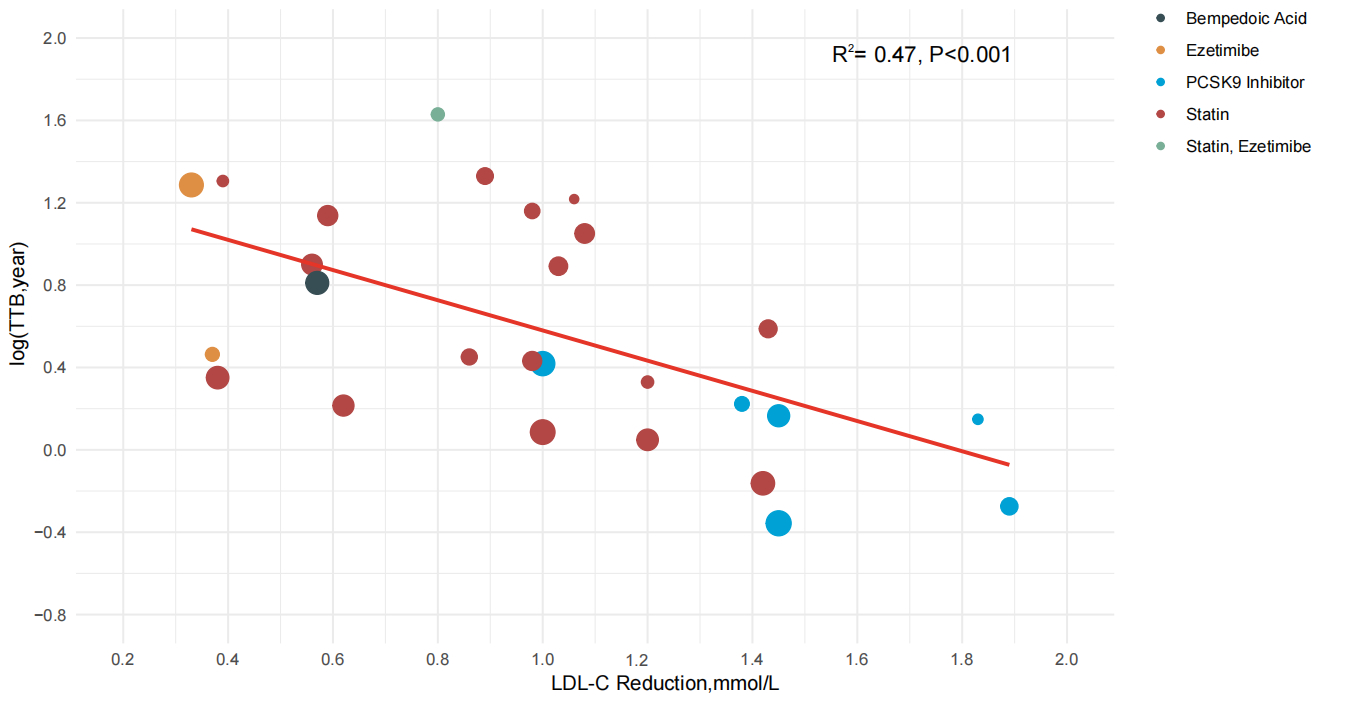
A total of 236985 participants (mean age, 62.5 years;29.5% women, mean baseline LDL-C of 2.94 mmol/L [114mg/dL]) from 27 trials with 28844 major adverse cardiovascular events were included. TTB was highly correlated with LDL-C lowering (Spearman’s r=-0.61, P<0.001). Logarithmic transformation of TTB was linearly correlated with the magnitude of LDL-C reduction (R2=0.47). The TTB for major cardiovascular events shorten 60% (95% CI, 42%-73%,P<0.001) per 1 mmol/L (38.7mg/dL) additional reduction in LDL-C level. Shortening TTB in secondary prevention population vs primary prevention population were 59% (35%-73%) vs 72% (10%-91%) (P=0.15) per 1 mmol/L additional reduction in LDL-C level. The addition of PCSK9 inhibitor, bempedoic acid and ezetimibe to statin shorten TTB by 71% (52%-82%), 41% (27%-52%) and 27% (16%-36%), respectively.
Conclusion
Intensive LDL-C lowering further shorten the time lag to clinical benefits. Therefore, it was expected to reduce more recent risk of adverse cardiovascular events. These results can help increase clinicians' confidence in making decisions about intensive LDL-C lowering therapy to achieve earlier clinical benefit.
  • Ou, Zhenhong  ( Chongqing General Hospital , Chongqing , China )
  • Cui, Kun  ( Chongqing General Hospital , Chongqing , China )
  • Liu, Xiaoqing  ( The Second Affiliated Hospital of Chongqing Medical University , Chongqing , China )
  • Author Disclosures:
    Zhenhong Ou: DO NOT have relevant financial relationships | Kun Cui: DO NOT have relevant financial relationships | Xiaoqing Liu: No Answer
Meeting Info:

Scientific Sessions 2024

2024

Chicago, Illinois

Session Info:

Imaging and Clinical Studies in Cardiovascular Diseases

Monday, 11/18/2024 , 10:30AM - 11:30AM

Abstract Poster Session

More abstracts on this topic:
A Polypill Strategy for Lipid Lowering and Anti-Platelet Therapy After Acute Coronary Syndrome: A Pilot Randomized Controlled Trial

Keshvani Neil, Wang Thomas, Pandey Ambarish, Coellar Juan David, Rizvi Syed Kazim, Jain Anand, Bustillo-rubio M. Karina, Segar Matthew, Lokesh Nidhish, Miller James, Yates Sean

9p21.3 variants drive coronary calcification by suppressing statherin expression

Soheili Fariborz, Almontashiri Naif, Heydarikhorneh Niloufar, Vilmundarson Ragnar, Chen Hsiao-huei, Stewart Alexandre

You have to be authorized to contact abstract author. Please, Login
Not Available