
Logo

American Heart Association

  108
  0


Final ID: MDP681

Retrospective Review of the Safety and Effectiveness of a Low Carbohydrate Ketogenic Diet in Overweight or Obese Patients with Heart Failure

Abstract Body (Do not enter title and authors here): Background: Recent evidence suggests a therapeutic role for ketosis in patients with heart failure (HF). However, little is known regarding the safety and effectiveness of a low carbohydrate ketogenic diet (LCKD) in patients with overweight or obesity and HF.
Purpose: To examine the safety and effectiveness of a LCKD in patients with overweight or obesity and HF.
Methods: A retrospective review from 2006-2024 was conducted of all patients with overweight or obesity and HF who followed a LCKD with clinical oversight for at least one year in a university health system. Changes in metabolic outcomes, echocardiographic measures, and medication use were assessed. Heart failure hospitalization (HFH) rates and rate ratios (RR) and all-cause mortality rates were calculated and stratified by HF classification.
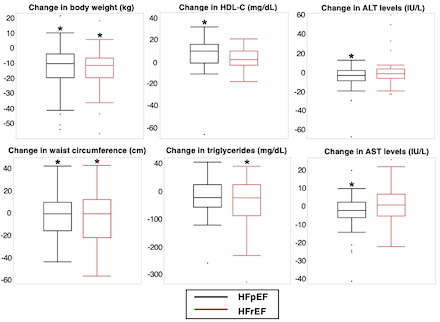
Results: A total of 125 patients met inclusion criteria, including 59 patients with HF with reduced ejection fraction (HFrEF) and 66 patients with HF with preserved ejection fraction (HFpEF). Patients lost a median (interquartile range) of 11.2 kg (-19.5, 4.4; p<0.0001) of body weight, and patients who adhered more strictly to the diet lost a larger percentage of body weight (p=0.0011). Aspartate amino-transferase and alanine amino-transferase levels decreased by a median (interquartile range) of 2.0 IU/L (-6.0, 2.5; p<0.05) and 3.0 IU/L (-8.8, 2.0; p<0.01), respectively, in patients with HFpEF. There were no significant changes in total cholesterol or LDL-C levels. Patients with type 2 diabetes significantly decreased their insulin dose while following a ketogenic diet (p<0.006). There were no significant changes in left ventricular ejection fraction, but the rate of HFH decreased significantly among all patients combined and patients with HFpEF while following the diet (RR=0.5; 95% CI: 0.4, 0.9 and RR=0.5; 95% CI: 0.3, 0.9; respectively) and decreased nonsignificantly among patients with HFrEF (RR=0.6; 95% CI: 0.3, 1.1). The overall all-cause mortality rate was 3.2 per 100 person-years of follow-up (95% CI: 1.0, 5.3).
Conclusion: A LCKD among patients with overweight or obesity and HF appears safe and effective for weight loss, with a potential additional benefit for improving metabolic markers and the rate of HFH.
  • Moseley, Garrett  ( Duke University School of Medicine , Durham , North Carolina , United States )
  • Harrington, Josephine  ( Duke University , Durham , North Carolina , United States )
  • Westman, Eric  ( Duke University , Durham , North Carolina , United States )
  • Yancy, William  ( Duke University , Durham , North Carolina , United States )
  • Author Disclosures:
    Garrett Moseley: DO NOT have relevant financial relationships | Josephine Harrington: DO have relevant financial relationships ; Consultant:Novo Nordisk:Active (exists now) | Eric Westman: No Answer | William Yancy: No Answer
Meeting Info:

Scientific Sessions 2024

2024

Chicago, Illinois

Session Info:

Cardiometabolic Conundrums in Heart Failure

Saturday, 11/16/2024 , 11:10AM - 12:25PM

Moderated Digital Poster Session

More abstracts on this topic:
More abstracts from these authors:
PREVENT the Perfect Storm: Managing Metabolic Syndrome

Harrington Josephine, Dixon Dave, Wilcox Jane

Ironing Out Infection Risk (PRO): IV Iron is More Harm Than Help

Angermann Christiane, Docherty Kieran, Khazanie Prateeti, Harrington Josephine

You have to be authorized to contact abstract author. Please, Login
Not Available