Geographic Disparities in Cardiometabolic Health Widened Across US States Between 2011 and 2021
Abstract Body (Do not enter title and authors here): Background Geographic inequities in cardiovascular mortality are pervasive in the US. Pandemic-related delays in screening and treatment, economic loss, and worsening social determinants may have widened geographic disparities in cardiometabolic health, particularly in states that were hardest hit by these spillover effects. Understanding changes in state-based inequities could inform targeted public health efforts to advance cardiovascular health.
Questions Did the prevalence of cardiometabolic risk factors (diabetes, hypertension, hyperlipidemia, obesity) and lifestyle factors (alcohol consumption, physical inactivity, tobacco use) change between 2011 and 2021? How did between-state differences change over this period?
Methods We included adults from the CDC’s Behavioral Risk Factor Surveillance System. Survey-weighted logistic regressions models were used to calculate age and sex-adjusted risk difference between states with the highest and lowest adjusted prevalence rates of each risk factor in 2011 and 2011, respectively. An interaction term for state and year was included to assess for differential changes in between-state disparities.
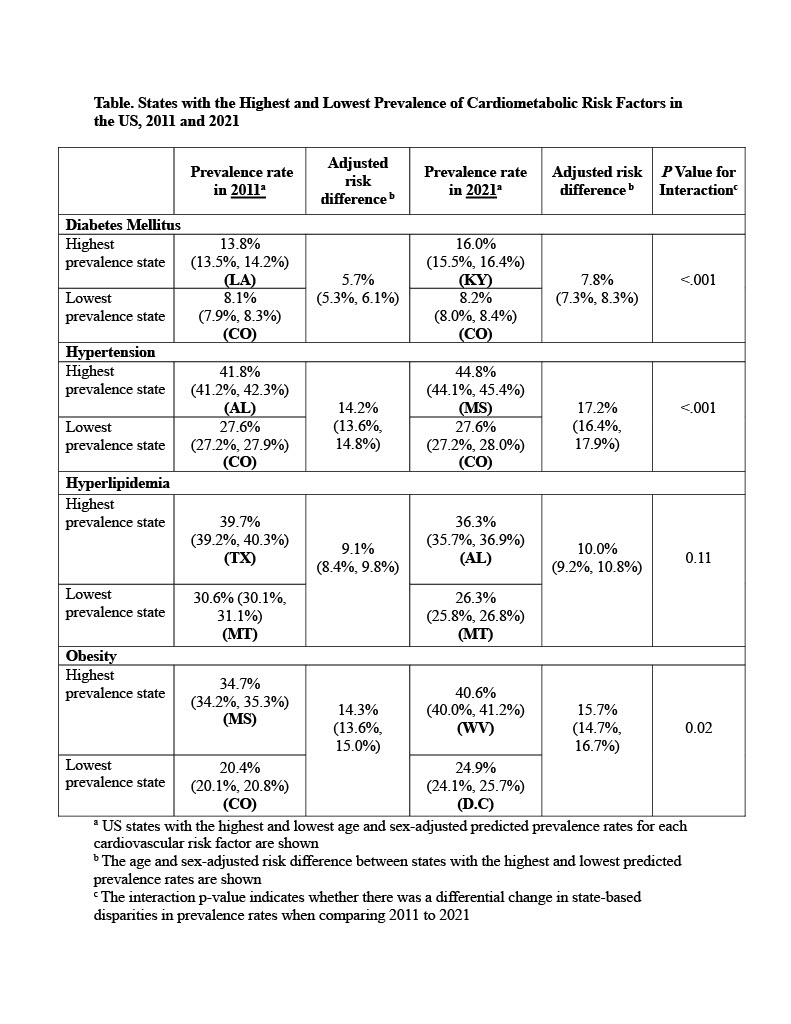
Results From 2011 to 2021, there were increases in the age- and sex-adjusted prevalence of diabetes (10.9% [95% CI, 10.7,11.0] to 12.4% [12.2,12.6]), hypertension (32.4% [32.1,32.7] to 33.7% [33.4,34.0]), and obesity (27.5% [27.2,27.7] to 33.1% [32.8,33.5]). Geographic inequities widened, with increases in the difference between states with the highest vs lowest prevalence of diabetes (5.7% [5.3,6.1] to 7.8% [7.3,8.3]), hypertension (14.2% [13.6,14.8] to 17.2% [16.4,17.9]) and obesity (14.3% [13.6,15.0] to (15.7% [14.7,16.7]) (Table). The prevalence of alcohol consumption (18.0% [17.7,18.2] to 15.6% [15.3,15.8]), physical inactivity (25.7% [25.4,27.4] to 24.0% [23.6,23.7]), and tobacco use (44.9% [44.5,45.3] to 36.3% [35.8,36.8]) decreased, and between-state differences did not widen.
Conclusion In this national study, the prevalence of hypertension, obesity, and diabetes increased from 2011 to 2021, and state-based inequities widened. Our findings highlight the urgent need for public health interventions to address widening state-based disparities in cardiometabolic health.
Gardner, Rachel
(
Brigham and Women's Hospital
, Newton , Massachusetts , United States )
Tale, Archana Pravin
(
Beth Israel Deaconess Medical Centr
, Boston , Massachusetts , United States )
Wadhera, Rishi
(
Beth Israel Deaconess Medical Centr
, Boston , Massachusetts , United States )
Author Disclosures:
Rachel Gardner:DO NOT have relevant financial relationships
| Archana Pravin Tale:No Answer
| Rishi Wadhera:DO NOT have relevant financial relationships