
Logo

American Heart Association

  99
  0


Final ID: MDP496

Machine learning-based prediction of heart rate at anaerobic threshold from cardiopulmonary exercise testing - a large-scale study in cardiovascular and healthy population

Abstract Body (Do not enter title and authors here): Background
For effective exercise prescription in cardiovascular patients, it is important to determine the target exercise heart rate (AT-HR) at the level of the anaerobic threshold. The AT-HR is usually obtained by cardiopulmonary exercise testing (CPX).
Objectives
The aim of this study is to develop a machine learning (ML) approach to predict AT-HR without CPX.
Methods
We used data from 21,491 patients who underwent CPX between 2004 and 2023. The data consisted of 71 features including vital signs, blood tests, and echocardiography. We predicted AT-HR using an ML-based model based on gradient boosting. The study sample was randomly divided into training (64% of patients), validation (16%), and test (20%) cohorts. In addition, the features were ranked based on feature selection using the trained model in terms of importance for predicting AT-HR.
Results
The test mean absolute error of AT-HR by the ML-based model was 7.7±0.2, otherwise, Karvonen methods with coefficient 0.7 or 0.4 were 34.3±0.2, 11.9±0.1. The feature ranking method showed that hsCRP, N-terminal pro-brain natriuretic peptide, creatine kinase, high-density lipoprotein cholesterol, and creatinine were important features for the prediction of AT-HR. The predictive performance with a limited number of features was comparable to that with all features.
Conclusions
The prediction of AT-HR by the ML-based model can improve the effectiveness of cardiac rehabilitation. We can reduce the required patient characteristics for AT-HR prediction by using the ranked features.
Clinical implementation
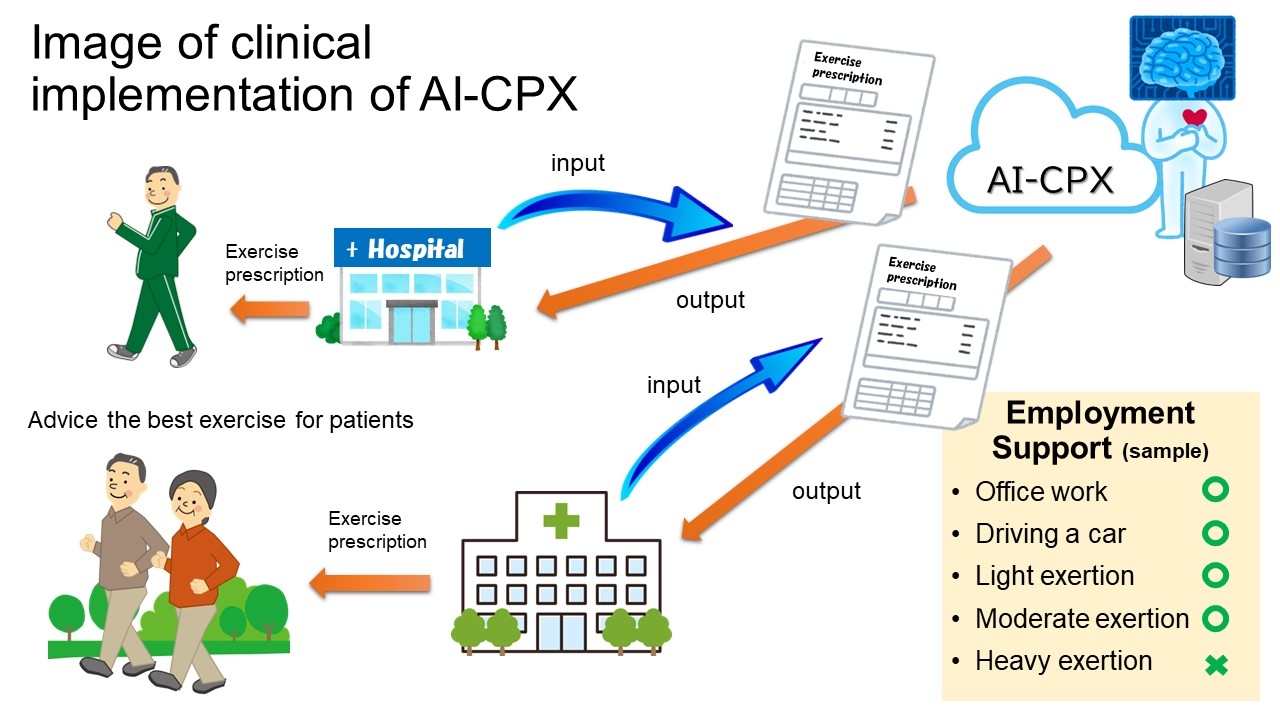
Our study showed that the prediction performance by the ML-based model with a limited number of features was comparable to that with all features. This result implies that we can reduce the cost and time to for obtaining patient characteristics to predict AT-HR for each patient. With this system, city hospitals and private clinics without CPX can obtain predicted AT-HR by entering basic information and provide aerobic exercise support to many patients based on the exercise prescription generated by the system. In addition, even in CPX facilities where frequent testing is not possible due to manpower and time constraints, this system can be used to frequently predict AT-HR and update exercise prescriptions in response to ever-changing cardiovascular conditions.
  • Nakayama, Atsuko  ( Sakakibara Heart Institute , Tokyo , Japan )
  • Author Disclosures:
    Atsuko Nakayama: DO have relevant financial relationships ; Researcher:NTT:Active (exists now)
Meeting Info:

Scientific Sessions 2024

2024

Chicago, Illinois

Session Info:

Enhancing Practice Through Innovation: Machine Learning, Electronic Nudges and More

Saturday, 11/16/2024 , 09:30AM - 10:45AM

Moderated Digital Poster Session

More abstracts on this topic:
Can We Diagnose Ticagrelor-induced Dyspnea After Urgent Percutaneous Coronary Intervention with Cardiopulmonary Exercise Testing?

Giverts Ilya, Andreev Denis, Nanda Saumya

Cardiopulmonary Exercise Testing for Characterization and Prognostication in Hypertrophic Cardiomyopathy: A Meta-Analysis

Landsteiner Isabela, Lewis Gregory, Masri Ahmad, Saberi Sara, Maron Martin, Mcginnis Shaina, Griskowitz Catharine, Newlands Chloe, Barriales-villa Roberto, Owens Anjali

More abstracts from these authors:
A Finding of Unique Peak Exercise Level in Respiratory Exchange Ratio during Bicycle Ergometric Cardiopulmonary Exercise Testing in Healthy Subjects

Nakayama Atsuko, Sakuma Hiroki, Iwata Tomoharu, Kashino Kunio, Isobe Mitsuaki, Tomoike Hitonobu

Multi-Center Validation of a Non-exercise Machine Learning Prediction Model Equivalent to Cardiopulmonary Exercise Parameters in Cardiovascular Patients

Nakayama Atsuko, Tomoike Hitonobu, Sakuma Hiroki, Bernard Joanny, Iwata Tomoharu, Kashino Kunio, Iso Yoshitaka, Kida Keisuke, Akashi Yoshihiro, Isobe Mitsuaki

You have to be authorized to contact abstract author. Please, Login
Not Available