Logo

American Heart Association

  142
  0


Final ID: Su4030

Clinical Characteristics and Outcomes of South Asians Presenting with Acute Coronary Syndrome

Abstract Body (Do not enter title and authors here): Background:
Patients of South Asian descent have a higher incidence of atherosclerotic cardiovascular disease and are affected by clinically significant coronary artery disease at an earlier age when compared to the general population. As a result, they have been shown to have a higher rate of cardiovascular events. This at-risk population has not been well studied as it pertains to acute coronary syndrome.

Methods:
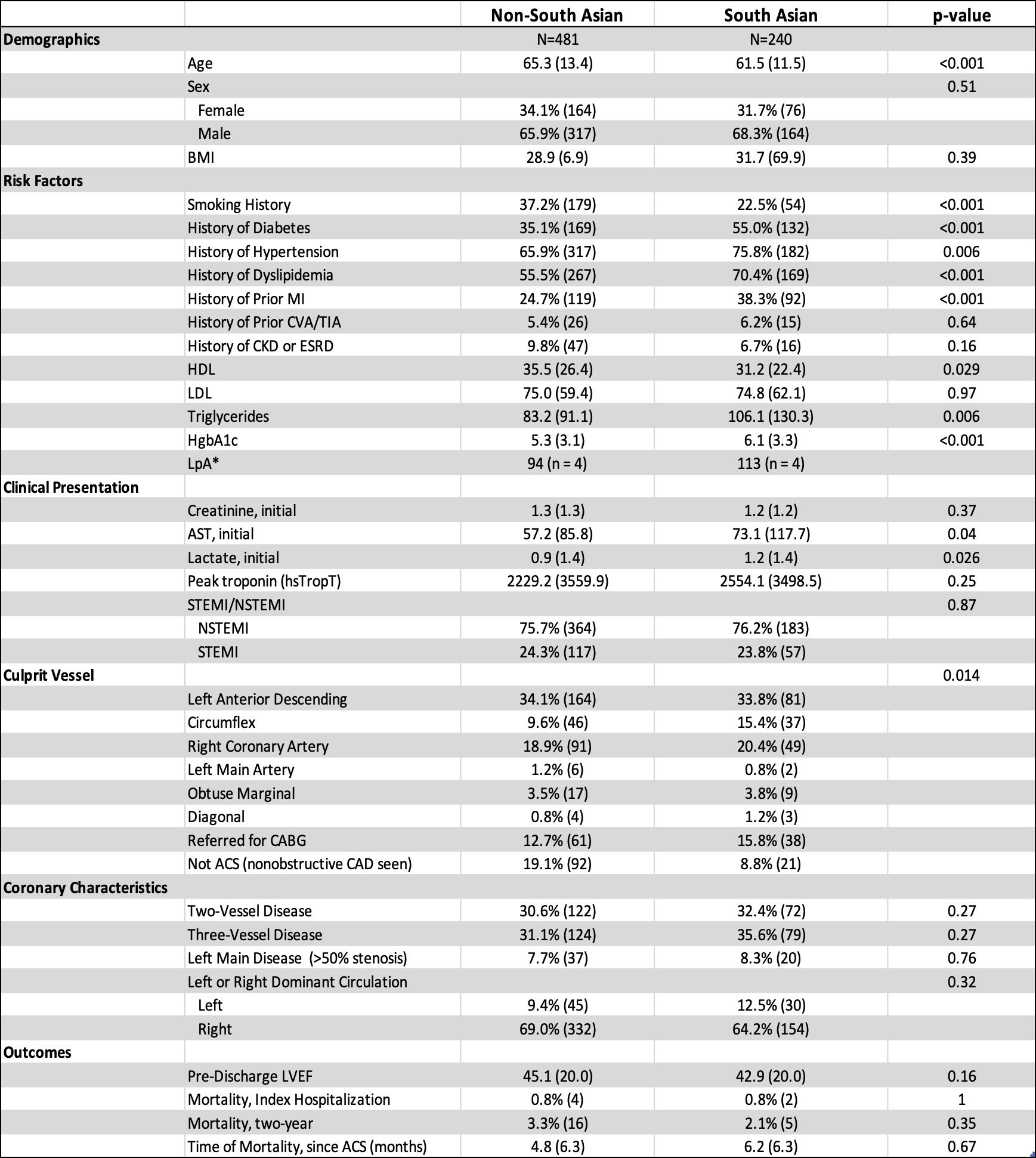
Out of 1610 patients who presented to one of two tertiary care centers between 2021-2022 with a diagnosis of acute coronary syndrome and underwent coronary angiography, 240 patients were identified as being South Asian and were included in the study. 480 non-South Asian patients were randomly selected as controls. A retrospective analysis was conducted to study the demographics, risk factors, clinical presentation, diagnostic features, and outcomes of the two groups.

Results:
South Asian patients who were diagnosed with acute coronary syndrome and underwent coronary angiography were significantly younger than non-South Asian patients (61 vs 65 years, p < 0.001). Though they were less likely to be smokers, they were significantly more likely to have other known risk factors including hypertension, dyslipidemia, and a history of prior myocardial infarction (p < 0.001). South Asians had mean lower HDL (p = 0.02), higher triglycerides (0.006), and higher Hgb A1C (p < 0.001). Surprisingly, rates of multivessel disease (defined as stenosis of 50% or greater in two or three vessels) were similar between the two groups. South Asians were more likely to be referred for CABG after initial coronary angiography most likely due to diffuse disease (p = 0.014). Clinical outcomes including pre-discharge LVEF, and 2-year mortality were similar between the groups.

Conclusions:
South Asians are a notoriously high-risk group when it comes to early-onset and more severe coronary artery disease. The pathophysiology behind this disproportionate manifestation of cardiovascular disease is not entirely understood, but several efforts to delineate this are ongoing. Our data demonstrate that this is at least in part, due to a higher prevalence of conventional modifiable and nonmodifiable risk factors in South Asian patients.
  • Patel, Humail  ( Northwell Health , Manhasset , New York , United States )
  • Bulsara, Kishen  ( Northwell Health , Manhasset , New York , United States )
  • Srivastava, Shreya  ( Northwell Health , Manhasset , New York , United States )
  • Hussain, Fahad  ( Northwell Health , Manhasset , New York , United States )
  • Dulmovits, Eric  ( Northwell Health , Manhasset , New York , United States )
  • Salam, Shafkat  ( Northwell Health , Manhasset , New York , United States )
  • Chandi, Mohit  ( Northwell Health , Manhasset , New York , United States )
  • Jauhar, Rajiv  ( Northwell Health , Manhasset , New York , United States )
  • Author Disclosures:
    Humail Patel: DO NOT have relevant financial relationships | Kishen Bulsara: DO NOT have relevant financial relationships | Shreya Srivastava: DO NOT have relevant financial relationships | Fahad Hussain: No Answer | Eric Dulmovits: DO NOT have relevant financial relationships | Shafkat Salam: DO NOT have relevant financial relationships | Mohit Chandi: DO NOT have relevant financial relationships | rajiv jauhar: DO NOT have relevant financial relationships
Meeting Info:

Scientific Sessions 2024

2024

Chicago, Illinois

Session Info:

The Intersection of Non-cardiac Pathologies and ACS

Sunday, 11/17/2024 , 03:15PM - 04:15PM

Abstract Poster Session

More abstracts on this topic:
Assessing the Efficacy of Preventive Percutaneous Coronary Intervention vs Optimal Medical Therapy for the Treatment of Vulnerable Plaque: A Meta-analysis

Mootz Nicholas, Rojulpote Chaitanya, Verma Divya, Harjai Kishore, Lin Chien-jung

Anticoagulation versus antiplatelet for secondary prevention in embolic stroke of undetermined source: The Cardiac Abnormalities in Stroke Prevention and Risk of Recurrence Study

Siegler James, Aboul-nour Hassan, De Havenon Adam, Culbertson Collin, Melkumova Emiliya, Jillella Dinesh, Dumitrascu Oana, Doolittle Charles, Yahnke Ian, Sathya Anvitha, Brown Samantha, Penckofer Mary, Kang Jieun, Bowman Anna, Brorson James, Shahrivari Mahan, Elangovan Cheran, Sloane Kelly, Alvi Muhammad, Krishnaiah Balaji, Kam Wayneho, Farooqui Mudassir, Badillo Goicoechea Elena, Nahab Fadi, Rojas-soto Diana, Sharma Richa, Thottempudi Neeharika, Nedelcu Simona, Smith Matthew, Herpich Franziska, Glover Patrick, Chahien Dalia, Sehgal Siddharth, Eklund Kelsey, Liebeskind David, Linares Guillermo, Daniel Jean-philippe, Al Kasab Sami, Singh Eesha, D'souza Marissa, Gaudio Elizabeth, Aziz Yasmin, Yaghi Shadi, Salehi Omran Setareh, Stretz Christoph, Thon Jesse, Lineback Christina, Khasiyev Farid, Kerrigan Deborah, Ali Hamid

More abstracts from these authors:
Evaluation of Gender, Racial and Ethnic Differences in Time to PCI in the Pre and Post Covid-19 Era

Jnani Jack, Alboucai Jack, Bulsara Kishen, Srivastava Shreya, Alvarez Villela Miguel, Griffin Matthew, Pierce Matthew, Kamel Maikel, Weintraub Spencer, George Riya, Impastato Brandon, Sood Aditya, Tsai Andrew, Hsieh Ji-cheng, Cheng Austin

The Utility of the Modified Shock Index (MSI) in Risk Stratification of Patients with STEMI

Jnani Jack, Alboucai Jack, Bulsara Kishen, Cheng Austin, Griffin Matthew, Alvarez Villela Miguel, Pierce Matthew, Weintraub Spencer, George Riya, Impastato Brandon, Kamel Maikel, Sood Aditya, Hsieh Ji-cheng, Srivastava Shreya, Tsai Andrew

You have to be authorized to contact abstract author. Please, Login
Not Available