
Logo

American Heart Association

  108
  0


Final ID: Sa2056

Safety and Efficacy of Mechanical Circulatory Support during VT ablation

Abstract Body (Do not enter title and authors here): Introduction:
Ventricular arrythmias are prevalent in patients with advanced heart failure and associated with increased mortality. Outcomes of electrophysiology ablation on patients requiring mechanical circulatory support (MCS) are not well described. We aimed to analyze the safety and efficacy of ventricular tachycardia (VT) ablation in patients requiring MCS at the Emory system.

Methods:
Patients were identified via retrospective chart review from October 2022 through August 2023. Patients who underwent VT ablation with the support of Impella, left ventricular assist device (LVAD), intra-aortic balloon pump (IABP), and venoarterial extra-corpeal membrane oxygenation (VA ECMO), or any combination of these were included.

Results:
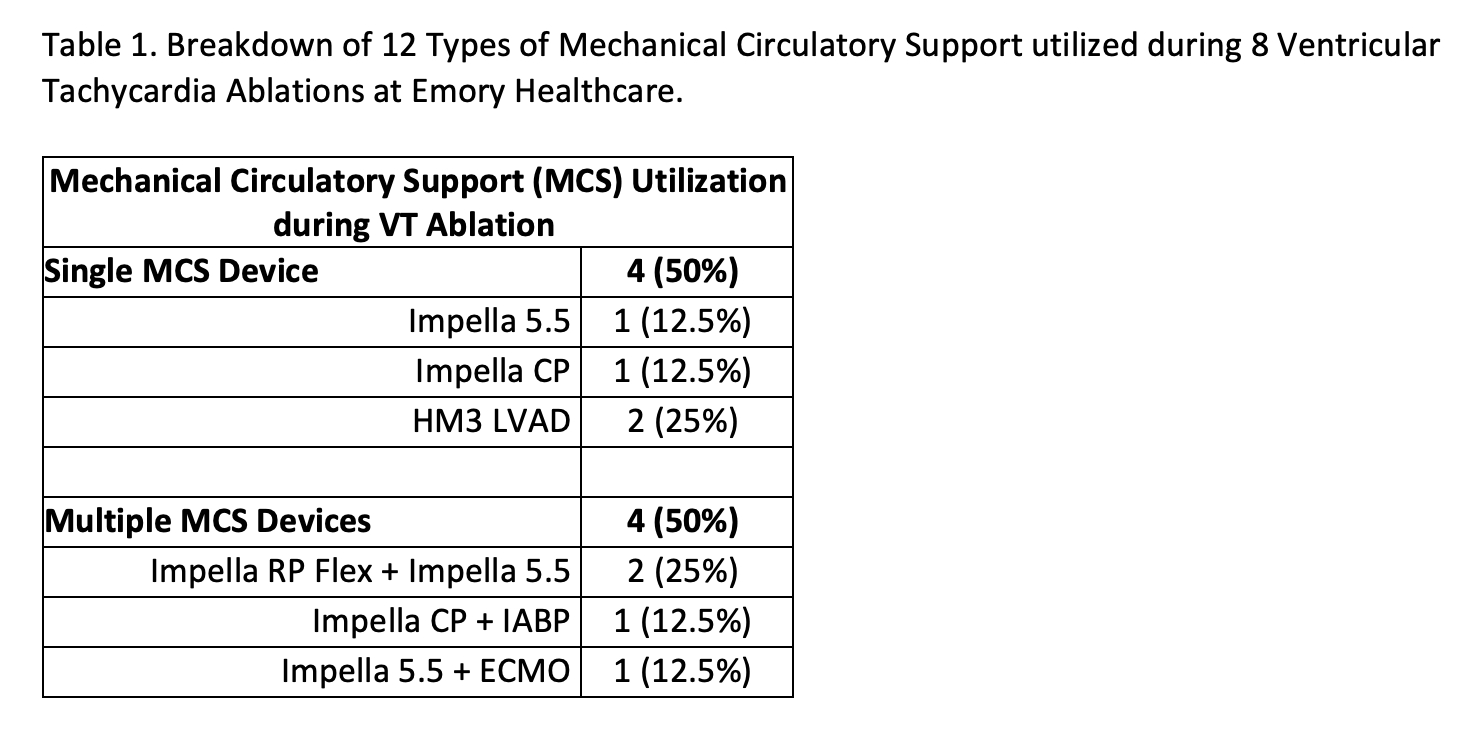
A total of 7 patients of average age 56 ± 10 years, predominantly male (85.7%), with cardiomyopathy of mean EF 18.6% +/- 8.5 (ischemic 71.4%) underwent MCS supported VT ablation. One patient had 2 separate VT ablation procedures for refractory VT. Of these 8 procedures, 4 utilized a single type of MCS (2 impella, 2 LVAD) while 4 used a second type of MCS in combination with an Impella (2 impella RP, 1 VA ECMO, 1 IABP). Success at time of ablation was present in 75% of cases. Average time of outpatient follow up was 82 ± 31 days. At time of follow up, 50% of patients remained free of VT or with a single VT episode not requiring implantable cardioverter-defibrillator (ICD) shock. One patient had gone on to undergo successful heart transplantation. Procedural complications were noted in one patient, who suffered cardioembolic cerebrovascular accident (CVA) 2 days post-op. Transthoracic echo (TTE) 5 days post-op revealed LV mural thrombus as likely etiology of CVA.

Conclusion:
While there are no clear guidelines directing the use of MCS during VT ablation, our single academic institution experience suggests safety and feasibility of its use to support select, high risk cases.
  • Pelling, Mary  ( Emory , Atlanta , Georgia , United States )
  • Debakey, Michael  ( Emory , Atlanta , Georgia , United States )
  • Sajja, Aparna  ( Emory , Atlanta , Georgia , United States )
  • Bhatia, Neal  ( Emory , Atlanta , Georgia , United States )
  • Shah, Anand  ( Emory , Atlanta , Georgia , United States )
  • Author Disclosures:
    Mary Pelling: DO NOT have relevant financial relationships | Michael Debakey: No Answer | Aparna Sajja: No Answer | Neal Bhatia: No Answer | Anand Shah: No Answer
Meeting Info:

Scientific Sessions 2024

2024

Chicago, Illinois

Session Info:

Learning & Burning: Insights into Ventricular Arrhythmia Management

Saturday, 11/16/2024 , 10:30AM - 11:30AM

Abstract Poster Session

More abstracts on this topic:
A Retrospective Analysis of Papillary Muscle PVC Ablations and Postprocedural Outcomes

Gulati Arvind, Praveen Niharika, Poddar Aastha, Futela Pragyat, Quelal Karol, Thomas Varghese Ben, Deshmukh Abhishek, Kowlgi Gurukripa

Ablation versus Anti-arrhythmic Drug Therapy for Ventricular Tachycardia in Patients with Ischemic Heart Disease: A Systematic Review and Meta-analysis of Randomized Controlled Trials

Khan Ubaid, Chaudhry Kashif, Amin Ahmed Mazen, A. Ibrahim Ahmed, Imran Muhammad, Rakab Mohamed, Iltaf Arej, M. Albarakat Majd, Ranabhat Chet, Brilliant Justin

More abstracts from these authors:
Use of Pre-procedural Computed Tomography for Ventricular Tachycardia and Pre-ventricular Contraction Ablations

Debakey Michael, Pelling Mary, Mekary Wissam, Sajja Aparna, Shah Anand, Bhatia Neal

Predictors Of The Need For Powered Extraction Sheaths During Transvenous Lead Extraction

Mekary Wissam, Tompkins Christine, Merchant Faisal, El-chami Mikhael, Bhatia Neal, Lloyd Michael, Westerman Stacy, Shah Anand, Leal Miguel, Delurgio David, Patel Anshul

You have to be authorized to contact abstract author. Please, Login
Not Available