

Utility of Coronary Artery Calcium Scoring in Low-Risk Patients: the Multi-Ethnic Study of Atherosclerosis (MESA)
Abstract Body (Do not enter title and authors here): Introduction: Coronary artery calcium (CAC) scoring is a powerful tool for atherosclerotic cardiovascular disease (ASCVD) risk assessment. Guidelines recommend consideration of CAC scoring in intermediate risk patients, but it’s utility in low and borderline risk patients is less clear.
Methods: We used data from 2,894 participants from MESA with low (<5%) or borderline (5-<7.5%) 10-year ASCVD risk defined by the pooled cohort equations (PCE). We evaluated the association between CAC score and coronary heart disease (CHD) and ASCVD risk using multivariable adjusted Cox proportional hazard models. We also evaluated if the addition of CAC to the pooled cohort equations (PCE) improved risk prediction using Harrell’s C-index and net reclassification improvement (NRI).
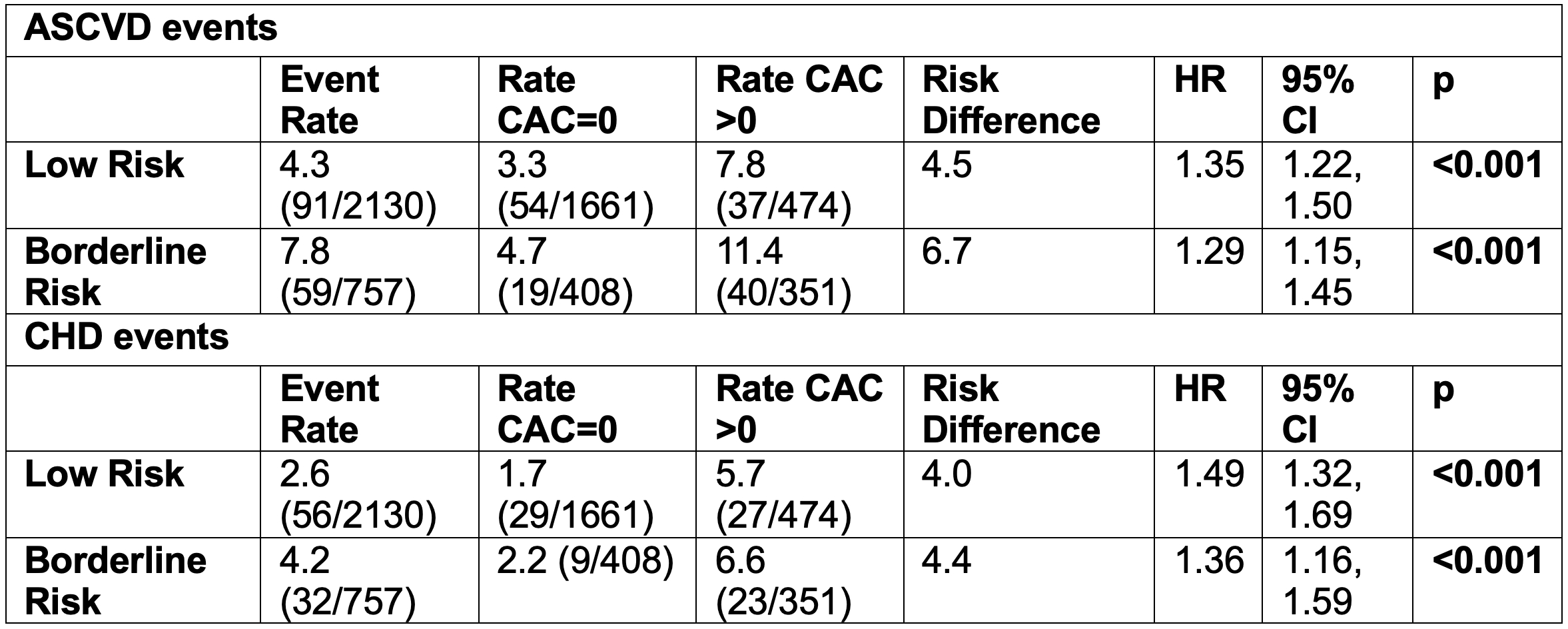
Results/Data: Mean age was 54.1 ± 5.8 years with 66.9% women. Among low-risk individuals, the ASCVD event rate was 3.3% with CAC=0, and 7.8% with CAC>0, and 4.7% vs. 11.4% among borderline-risk individuals. Natural-log transformed CAC score was associated with increased ASCVD risk in low-risk (HR 1.35, 95% CI 1.22-1.50) and borderline-risk (HR 1.29, 95% CI 1.15-1.45) individuals. Similar results were seen for CHD with higher HRs (Table 1). The addition of CAC to the PCE improved the C-index (SE) among low/borderline risk individuals from 0.620 (0.023) to 0.671 (0.024). Continuous NRI was also significant with the addition of CAC to the PCE in low/borderline risk (0.422, 95% CI 0.248-0.611). Greater improvement was seen for CHD (Table 2).
Conclusions: The presence of CAC in low and borderline risk individuals is associated with increased ASCVD and CHD risk. The addition of CAC scoring to the PCE improved risk prediction in low and borderline risk individuals, suggesting potential clinical utility in this population.
Davis, Jonathan
(
UCSD
, San Diego , California , United States )
Razavi, Alexander
(
Emory University
, Atlanta , Georgia , United States )
Ellberg, Charlotte
(
UCSD
, San Diego , California , United States )
Blaha, Michael
(
JOHNS HOPKINS HOSPITAL
, Baltimore , Maryland , United States )
Criqui, Michael
(
UCSD
, La Jolla , California , United States )
Bhatia, Harpreet
(
University of California San Diego
, San Diego , California , United States )
Author Disclosures:
Jonathan Davis:DO NOT have relevant financial relationships
| Alexander Razavi:DO NOT have relevant financial relationships
| Charlotte Ellberg:DO NOT have relevant financial relationships
| Michael Blaha:DO have relevant financial relationships
;
Research Funding (PI or named investigator):Bayer:Active (exists now)
; Advisor:New Amsterdam:Expected (by end of conference)
; Advisor:Vectura:Past (completed)
; Advisor:Agepha:Active (exists now)
; Advisor:Astra Zeneca:Past (completed)
; Advisor:Eli Lilly:Active (exists now)
; Advisor:Boehringer Ingelheim:Active (exists now)
; Advisor:Roche:Past (completed)
; Advisor:Merck:Past (completed)
; Advisor:Bayer:Active (exists now)
; Advisor:Novartis:Active (exists now)
; Advisor:Novo Nordisk:Active (exists now)
; Researcher:Amgen:Past (completed)
| Michael Criqui:DO NOT have relevant financial relationships
| Harpreet Bhatia:DO have relevant financial relationships
;
Consultant:Kaneka:Past (completed)
; Advisor:Arrowhead:Active (exists now)
; Advisor:Abbott:Active (exists now)
; Advisor:Novartis:Active (exists now)
; Consultant:Novartis:Active (exists now)