
DAPT for 1-Month Followed by P2Y12 Inhibitor Monotherapy Versus DAPT for 12-Months After Percutaneous Coronary Intervention: A Systematic Review and Meta Analysis of Randomized Controlled Trials
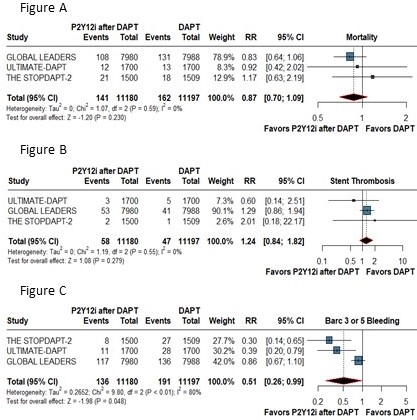
Abstract Body (Do not enter title and authors here): Background: Dual antiplatelet therapy (DAPT) is well established as standard of care following percutaneous coronary intervention (PCI). Recent trials have shown a potential benefit in the reduction of hemorrhagic events with a shorter course of DAPT. However, the optimal duration of DAPT following PCI remains unclear. Question: Is 1 month of DAPT followed by P2Y12 inhibitor monotherapy superior to the standard 12-month DAPT regimen in terms of cardiovascular outcomes in patients post-PCI? Methods: Medline, PubMed, and Cochrane Central Register of Controlled Trials databases were searched for randomized clinical trials (RCTs) comparing 1-month vs. 12-months of DAPT followed by P2Y12 inhibitor monotherapy post-PCI. The outcomes of interest were cardiovascular death, myocardial infarction, and major bleeding. We used R version 4.1.2 (The R Foundation, 2021) to pool the data using a random-effects model. Heterogeneity was assessed with I2. Results: We included three RCTs reporting data from 22,413 patients, of whom 11,180 (49.8%) were treated with 1-month of DAPT, followed by P2Y12 inhibitor monotherapy. Follow-up ranged from 12 months to 24 months. The incidence of all-cause death (RR 1.20; 95% CI 0.95-1.51; p=0.12) and myocardial infarction (RR 0.86; 95% CI 0.71-1.05; p=0.14) were not significantly different between the groups. However, major bleeding (RR 0.51; 95% CI 0.26-0.99; p=0.048) was significantly reduced with a short course of DAPT followed by P2Y12 inhibitor monotherapy, as compared with standard 12 months of DAPT. Conclusion: Following PCI, a transition from DAPT to P2Y12 inhibitor monotherapy at 1-month is associated with a significant reduction in major bleeding as compared with standard DAPT for 12-months, with no significant change in the incidence of all-cause mortality or myocardial infarction.
De Souza Faria, Giovana
(
Faculdade de Medicina Barão de Mauá
, Ribeirão Preto , Brazil )
Bombassaro Masiero, Barbara
(
Pontifical Catholic University of Rio Grande do Sul
, Rio Grande do Sul , Brazil )
Doma, Mohamed
(
Alexandria faculty of medicine
, Alexandria , Egypt )
Manuel, Valdano
(
Comple Hospitalar de Doenças Cardio-Pulmonares Cardeal Dom Alexandre do Nascimento
, Luanda , Luanda , Angola )
Tinajero, Shirley
(
hospital de Especialidades Santa Margarita Ecuador
, Equador , Brazil )
Author Disclosures:
Capela Pascoal:DO NOT have relevant financial relationships
| Ocilio Ribeiro Goncalves:No Answer
| Hilária Saugo Faria:DO NOT have relevant financial relationships
| Antonino Francisco:No Answer
| Giovana de Souza Faria:DO NOT have relevant financial relationships
| Barbara Bombassaro Masiero:DO NOT have relevant financial relationships
| Mohamed Doma:DO NOT have relevant financial relationships
| Valdano Manuel:No Answer
| Shirley Tinajero:DO NOT have relevant financial relationships