
Logo

American Heart Association

  169
  0


Final ID: Mo2043

Early Findings on the Impact of Renin-Angiotensin-Aldosterone System Inhibitors on Bicuspid Aortic Valve Disease Progression: A Single Center Cohort Study

Abstract Body (Do not enter title and authors here): Introduction: Patients with a bicuspid aortic valve (BAV) often have an associated aortopathy, increasing their risk of aortic dissection. Currently, there is no proven therapy to stabilize the growth of BAV aortopathy. This study aimed to assess the effect of cardioprotective medications, specifically renin-angiotensin-aldosterone system inhibitors (RAASi), on the progression of aortic dilation in adult BAV patients.
Methods: A retrospective cohort study was conducted including adult patients with BAV followed at our center between 1996-2020. All patients had echocardiography imaging with at least 5 years of follow-up. The cohort was divided based on the chronic use of RAASi, as determined by pharmacy check-out data. The primary endpoint was defined as either the progression of ascending aortic diameter ≥ 4.5 cm or surgery for ascending aortic replacement.
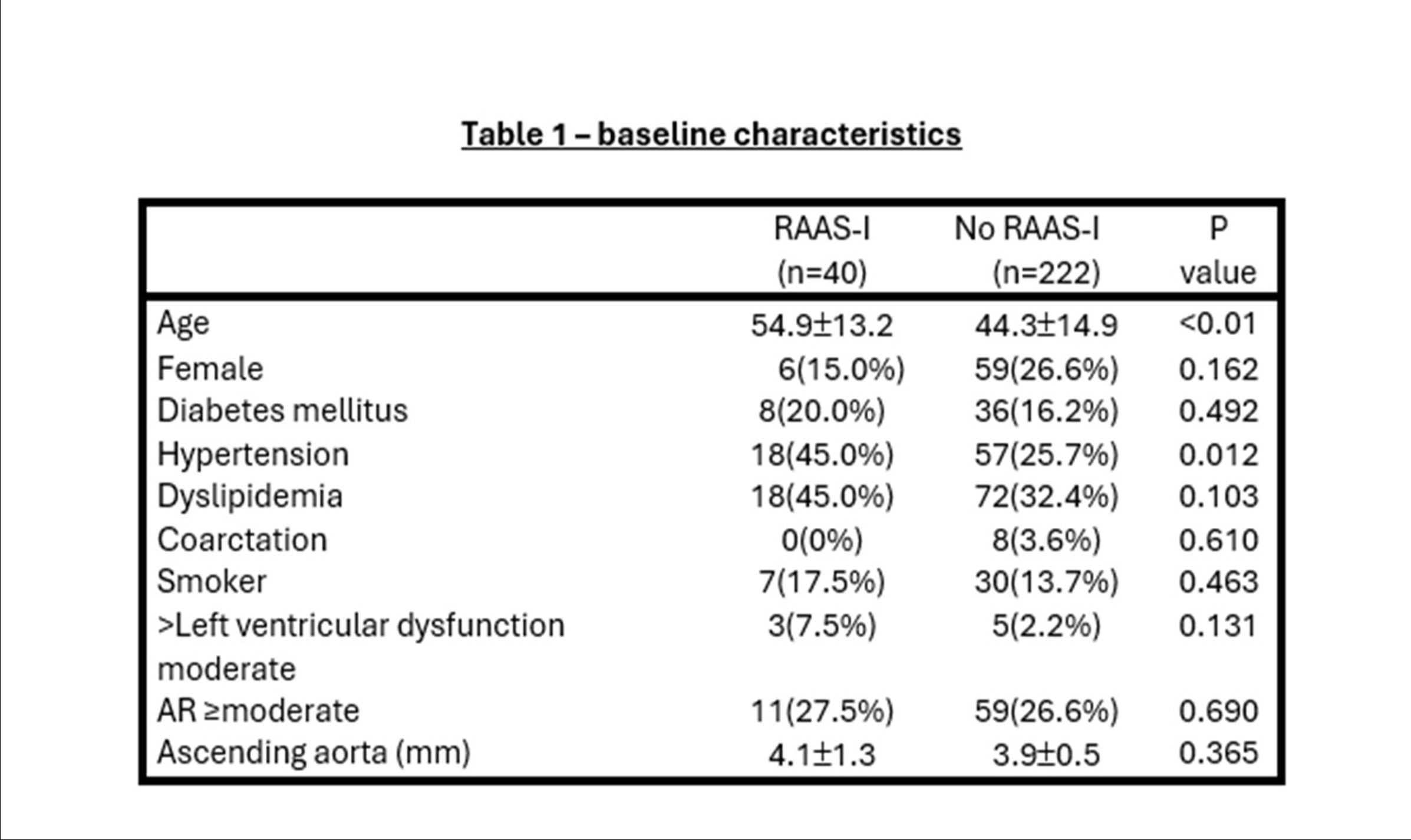
Results: The study included 262 patients with a mean age of 54.3±19.5 years, of whom 75.2% (n=197) were male, and 34.7% (n=44) had a diagnosis of hypertension. At baseline, the average size of the ascending aorta was 4.2±4.1 mm and 3.5±4.0 mm at the level of the aortic sinuses. The average follow-up time was 5.8±0.8 years. During follow-up, 23 patients underwent ascending aortic replacement with concurrent aortic valve replacement, 66 patients experienced progression of ascending aortic diameter ≥ 4.5 cm, and 2 patients died. Patients using RAASi (n=40) had a lower incidence of the primary endpoint compared to those without RAASi chronic therapy (12.8% vs. 24.8%, p=0.147). Multivariate analysis indicated that patients without RAASi chronic therapy had a significantly increased risk of the primary endpoint (HR=2.87, 95% CI [1.03-8.01], p=0.43).
Conclusions: Our early findings suggest that RAASi may have a preventative role in the progression of BAV aortopathy.
  • Brem, Ofir  ( Tel Aviv University , Tel Aviv-Yafo , Israel , Israel )
  • Samuels, Elchanan  ( Tel Aviv University , Tel Aviv-Yafo , Israel , Israel )
  • Bental, Tamir  ( Rabin Medical Center , Petach Tikva , Israel )
  • Richter, Ilan  ( Rabin Medical Center , Petach Tikva , Israel )
  • Kornowski, Ran  ( Rabin Medical Center , Petach Tikva , Israel )
  • Hirsch, Rafael  ( Rabin Medical Center , Petach Tikva , Israel )
  • Witberg, Guy  ( Rabin Medical Center , Petach Tikva , Israel )
  • Schamroth Pravda, Nili  ( Rabin Medical Center , Petach Tikva , Israel )
  • Author Disclosures:
    Ofir Brem: DO NOT have relevant financial relationships | Elchanan Samuels: No Answer | Tamir Bental: No Answer | Ilan Richter: DO NOT have relevant financial relationships | Ran Kornowski: DO NOT have relevant financial relationships | Rafael Hirsch: No Answer | Guy Witberg: No Answer | Nili Schamroth Pravda: DO NOT have relevant financial relationships
Meeting Info:

Scientific Sessions 2024

2024

Chicago, Illinois

Session Info:

Adult Congenital Heart Disease

Monday, 11/18/2024 , 01:30PM - 02:30PM

Abstract Poster Session

More abstracts on this topic:
Angiotensin II vascular abnormalities in 32.5% of 3322 patients with essential hypertension(EH): Use of angiotensin II analogue, saralasin.

Anderson Gunnar

Acceptability and Feasibility Of A Digital Health Intervention For Adults with Congenital Heart Disease

Valente Joseph, Reardon Leigh, Moons Philip, Okumura Megumi, Gurvitz Michelle, Agarwal Anushree, Banala Keerthana, Buenrostro Karina, Alano Lindsay, Duan Rong, Parang Kim, Manyan Karina, Bravo-jaimes Katia, Norris Mark

You have to be authorized to contact abstract author. Please, Login
Not Available