
Logo

American Heart Association

  115
  0


Final ID: Sa4070

Navigating Aspirin Allergy With Rapid Desensitization In A Patient Requiring Urgent Coronary Intervention

Abstract Body (Do not enter title and authors here): Introduction
Aspirin (ASA) hypersensitivity is a challenge in determining the appropriate, cost-effective therapy in patients after percutaneous coronary intervention (PCI). Various ASA desensitization protocols were studied and showed favorable outcomes. In this case, we highlight the use of rapid ASA desensitization protocols for patients requiring dual antiplatelet therapy (DAPT) post urgent PCI.

Case
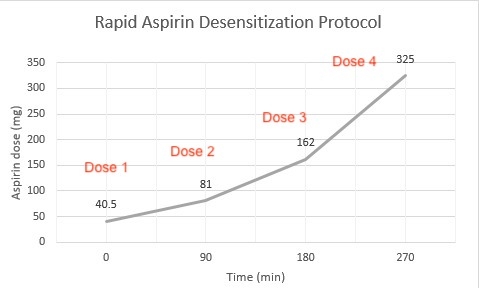
A 52-year-old male presented with severe left-sided chest pain associated with diaphoresis. He had a history of allergic reaction to ASA at the age of 18 years with swelling of the face and throat without shortness of breath or hypotension. Physical examination was unremarkable except for tachycardia. Workup showed no ECG abnormalities but significantly elevated, uptrending high sensitivity troponin. Medical management included clopidogrel load, heparin drip, and nitropaste for persistent pain. Urgent coronary angiography showed a severe bifurcating lesion in the LCx and OM1 arteries, successfully treated with the T stent technique using a drug-eluting stent. He received cilostazol and prasugrel, overlapped with a tirofiban drip post PCI. ASA desensitization was performed with oral ASA every 90 minutes for four doses (Figure). Vital signs were monitored every 30, 60, and 90 minutes after each dose. He was discharged home with no reported symptoms on follow up.

Discussion
DAPT with ASA and oral P2Y12 inhibitors is recommended for patients with PCI. ASA desensitization could be considered for patients who are intolerant to ASA. Major clinical ASA desensitization protocols, like in ADAPTED and SCRIPPS studies, showed good outcomes in major adverse cardiovascular events. However, one limitation of these widely used protocols is the prolonged time required to achieve desensitization. The rapid protocol used in our patient who did not have ASA exacerbated respiratory disease showed effectiveness with shorter hospital stay.

Conclusion
ASA desensitization is an appropriate option for patients with a history of ASA allergy requiring DAPT. Rapid desensitization protocols are associated with shorter hospitalization courses, and future efforts should evaluate their effectiveness in randomized controlled trials.
  • Daghstani, Omar  ( Albany Medical College , Albany , New York , United States )
  • Derakhshesh, Matthew  ( Albany Medical Center , Albany , New York , United States )
  • Ghazal, Mohamad  ( Albany Medical College , Albany , New York , United States )
  • Lyubarova, Radmila  ( Albany Medical College , Albany , New York , United States )
  • Author Disclosures:
    Omar Daghstani: DO NOT have relevant financial relationships | Matthew Derakhshesh: DO NOT have relevant financial relationships | Mohamad Ghazal: DO NOT have relevant financial relationships | Radmila Lyubarova: No Answer
Meeting Info:

Scientific Sessions 2024

2024

Chicago, Illinois

Session Info:

Vascular and Microvascular Considerations for Coronary Intervention

Saturday, 11/16/2024 , 10:30AM - 11:30AM

Abstract Poster Session

More abstracts on this topic:
Antithrombotic trends before and after publication of randomized clinical trials in cervical artery dissection: A secondary analysis of the STOP-CAD Study

Penckofer Mary, Salehi Omran Setareh, Seiffge David, Arnold Marcel, Marialuisa Zedde, Zubair Adeel, Marto Joao Pedro, Ghannam Malik, Engelter Stefan, Traenka Christopher, Mac Grory Brian, Shu Liqi, Kam Wayneho, Elnazeir Marwa, Romoli Michele, Saleh Velez Faddi, Siegler James, Strelecky Lukas, Yaghi Shadi, Henninger Nils, Muppa Jayachandra, Bakradze Ekaterina, Heldner Mirjam, Katheryna Antonenko

Aspirin Use in Men is Independently Associated with Slower Growth Rate of Ascending Thoracic Aortic Aneurysms

Tu Sally, Kailash Vidur, Gomez Axel, Pace William, Huang Yixuan, Boskovski Marko, Ge Liang, Tseng Elaine

More abstracts from these authors:
Stealing from the Heart: A Case of Angina due to Coronary-Bronchial Artery Fistula after Pulmonary Embolism

Fordham Matthew, Ghazal Mohamad, Derakhshesh Matthew, Daghstani Omar, Nappi Anthony, Lyubarova Radmila, Belov Dmitri

You have to be authorized to contact abstract author. Please, Login
Not Available