
Electrochemical Impedance Spectroscopy Unmasks High-Risk Atherosclerotic Features in Human Coronary Artery Disease
Abstract Body (Do not enter title and authors here): Background Coronary plaque rupture remains the prominent mechanism of myocardial infarction. Accurate identification of rupture-prone plaque may improve clinical management. This study assessed the discriminatory performance of electrochemical impedance spectroscopy (EIS) in human cardiac explants to detect high-risk atherosclerotic features that portend rupture risk.
Methods In this single-center, prospective study, n=26 cardiac explants were collected for EIS interrogation of the three major coronary arteries. Vessels in which advancement of the EIS catheter without iatrogenic plaque disruption was rendered impossible were not assessed. N=61 vessels underwent EIS measurement and histological analyses. Plaques were dichotomized according to previously established high rupture-risk parameter thresholds. Diagnostic performance was determined via receiver operating characteristic areas-under-the-curve (AUC).
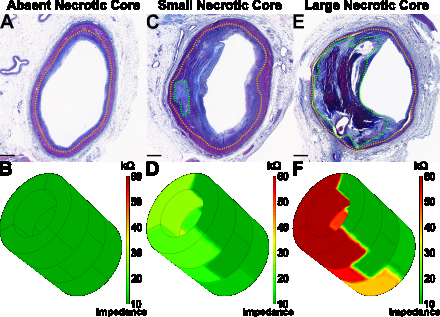
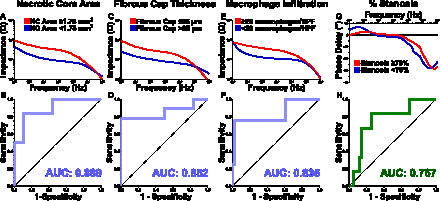
Results Necrotic cores were identified in n=19 vessels (median area 1.53 mm2) with median fibrous cap thickness of 62 μm. Impedance was significantly greater in plaques with necrotic core area ≥1.75 mm2 vs <1.75 mm2 (19.8±4.4 kΩ vs 7.2±1.0 kΩ, P=0.019), fibrous cap thickness ≤65 μm vs >65 μm (19.1±3.5 kΩ vs 6.5±0.9 kΩ, P=0.004), and ≥20 macrophages per 0.3 mm-diameter high-power field (HPF) vs <20 macrophages per HPF (19.8±4.1 kΩ vs 10.2±0.9 kΩ, P=0.002). Impedance identified necrotic core area ≥1.75 mm2, fibrous cap thickness ≤65 μm, and ≥20 macrophages per HPF with AUCs of 0.889 (95% CI: 0.716–1.000) (P=0.013), 0.852 (0.646—1.000) (P=0.025), and 0.835 (0.577—1.000) (P=0.028), respectively. Further, phase delay discriminated severe stenosis (≥70%) with an AUC of 0.767 (0.573—0.962) (P=0.035).
Conclusions EIS discriminates high-risk atherosclerotic features that portend plaque rupture in human coronary artery disease and may serve as a complementary modality for angiography-guided atherosclerosis evaluation.
Chen, Michael
(
UCLA DGSOM
, Los Angeles , California , United States )
Suwanaphoom, Krit
(
UCLA DGSOM
, Los Angeles , California , United States )
Sanaiha, Yas
(
UCLA DGSOM
, Los Angeles , California , United States )
Luo, Yuan
(
State Key Laboratory of Transducer Technology, Shanghai Institute of Microsystem and Information Technology, Chinese Academy of Sciences
, Shanghai , China )
Benharash, Peyman
(
UCLA DGSOM
, Los Angeles , California , United States )
Fishbein, Michael
(
UCLA DGSOM
, Los Angeles , California , United States )
Packard, Rene
(
UCLA DGSOM
, Los Angeles , California , United States )
Author Disclosures:
Michael Chen:DO NOT have relevant financial relationships
| Krit Suwanaphoom:No Answer
| Yas Sanaiha:No Answer
| Yuan Luo:No Answer
| Peyman Benharash:No Answer
| Michael Fishbein:DO NOT have relevant financial relationships
| Rene Packard:DO have relevant financial relationships
;
Consultant:GE Healthcare:Active (exists now)