
Logo

American Heart Association

  110
  0


Final ID: Sa4167

Targeting GPR39 for Hypoxia-induced Pulmonary Hypertension in Mice

Abstract Body (Do not enter title and authors here): Background: Primary pulmonary arterial hypertension (PAH) is a disease affecting young subjects. It has very poor prognosis and optimal treatment is not available. 15-hydroxyeicosatetraenoic acid (15-HETE), a potent vasoconstrictor, has been implicated in the pathogenesis of PAH. Elevated levels of 15-HETE have been shown to be associated with worse prognosis in patients with PAH. Oral ingestion of 15-HETE leads to development of PAH in rodents. We recently showed that 15-HETE is the endogenous agonist for the G-protein coupled receptor 39 (GPR39) present in vascular smooth muscle cells.
Hypothesis: We, therefore, hypothesized that global deletion of GPR39 (knock-out [KO] mice) would protect from PAH by removing the receptor through which 15-HETE causes vasoconstriction.
Methods: Accordingly, 13 wild-type (WT) and 16 KO mice were placed in a hypoxia chamber (10% O2). Litter-mate controls (7 WT and 13 KO) were subjected to normoxia (room air, 21% O2). At the end of 4 weeks heart rate as well as aortic and right ventricular (RV) pressures were measured (latter using micromanometer-tipped catheter), and the animals were then euthanized for measurement of RV wall thickness and RV size from which RV wall stress was calculated.
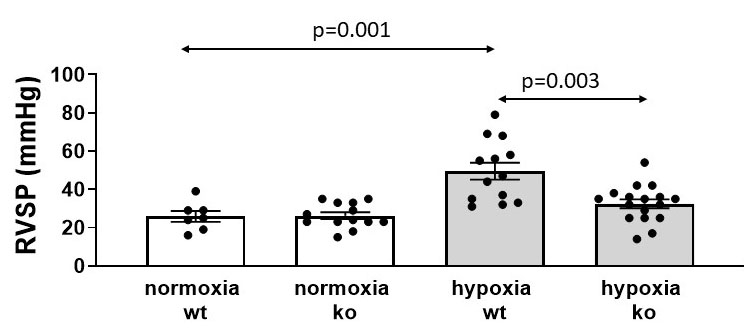
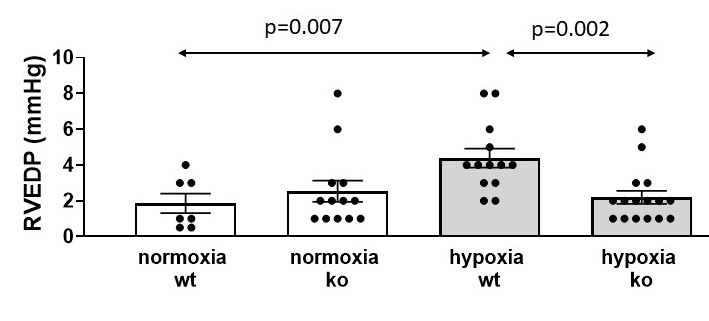
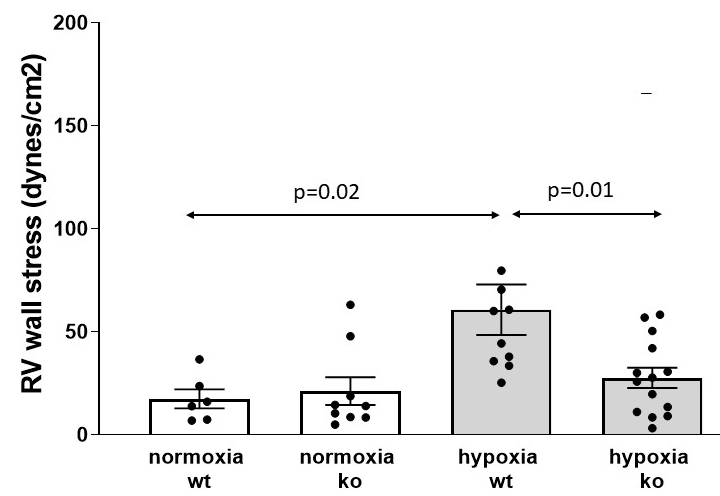
Results: Heart rate and systolic blood pressure were not different between the 4 groups. WT hypoxic animals developed PAH with peak RV systolic pressures (RVSP) being significantly higher than normoxic WT and hypoxic WT and hypoxic KO mice. (Figure 1) Similar results were noted for RV end-diastolic pressure (Figure 2) and RV wall stress (Figure 3).
Conclusions: By deleting GPR39, the target for 15-HETE, we were able to prevent hypoxia induced PAH and RV dysfunction. Pharmacological inhibition of GPR39 may open new frontiers in the treatment of PAH.
  • Methner, Carmen  ( Oregon Health Science University , Portland , Oregon , United States )
  • Liu, Lijuan  ( Oregon Health Science University , Portland , Oregon , United States )
  • Kaul, Sanjiv  ( Oregon Health Science University , Portland , Oregon , United States )
  • Author Disclosures:
    Carmen Methner: DO NOT have relevant financial relationships | Lijuan Liu: No Answer | Sanjiv Kaul: DO NOT have relevant financial relationships
Meeting Info:

Scientific Sessions 2024

2024

Chicago, Illinois

Session Info:

A Medley of All Things Pulmonary Hypertension

Saturday, 11/16/2024 , 02:00PM - 03:00PM

Abstract Poster Session

More abstracts on this topic:
ANDES-CHD-AI study: A New algorithm DEtectS critical Congenital Heart Disease using Artificial Intelligence at different altitudes

Bravo-jaimes Katia, Mallma Majhifl, Sharma Grishma, Gamarra-valverde Norma, Velarde Zegarra Luis, Blas Ortiz Karem Beatriz, Cordova Paucarchuco Daniel Odiseo, Astete Valdez Beatriz Regina, Aguirre Jimenez Joaquin, Cutipa Apaza Nicol Alexandra, Jaramillo Ospina Luisa Fernanda, Nombera Aznaran Milagros, Triveno Huamannahui Jenny, Avila Arias Diana Nathaly, Laura Cabrera Mabel, Vargas Montano Alessandra, Mcleod Christopher, Carter Rickey, Davila Carmen, Tolentino Gabancho Priscila Carol, Ordaz Paulina, Martinez Leslie, Galdos Jorge, Rosales Claudio William Walt, Chavez Edgar

Chronic cerebral hypoperfusion impairs brain iron metabolism in aged mice

Monga Sheelu, Moruno-manchon Jose

More abstracts from these authors:
Coronary Autoregulation Requires Arachidonic Acid and GPR39

Kajimoto Masaki, Methner Carmen, Kaul Sanjiv

Reduction in Myocardial Infarct Size by GPR39 Inhibition Maybe Related to its Direct Tissue Effects

Thompson Allura, Methner Carmen, Liu Lijuan, Plascencia Mary, Kajimoto Masaki, Kaul Sanjiv

You have to be authorized to contact abstract author. Please, Login
Not Available